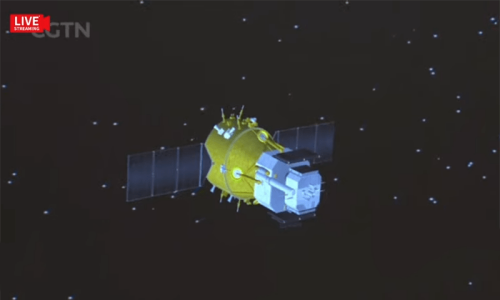
A Japanese startup will attempt a tricky lunar touchdown on Friday with an unmanned lander named Resilience, two years after its first try which crashed onto the moon’s surface.
If successful, it will be only the third private mission to the Earth’s rocky natural satellite ever completed, and the first by a company based outside of the United States.
The startup, ispace, says touchdown is expected at 4:17am Japan time on Friday (1917 GMT on Thursday) with the potentially nail-biting attempt streamed on its website.
Resilience is “ready to attempt a historic landing on the moon” and “we are confident in our preparations for success”, ispace CEO Takeshi Hakamada said last week.
“We have leveraged the operational experience gained in Mission 1 and during this current voyage to the moon,” he said in a statement.
Only five nations have soft-landed spacecraft on the moon: the Soviet Union, the US, China, India and Japan.
Companies are vying to offer cheaper and more frequent space exploration opportunities than governments.
Last year, the Houston-based Intuitive Machines became the first private enterprise to touch down on the moon. Although its uncrewed craft landed at the wrong angle, it was still able to complete tests and send photos.
Then in March this year, Firefly Aerospace’s Blue Ghost — launched on the same SpaceX rocket as ispace’s Resilience — aced its lunar landing attempt.
Despite their rocket ride-share, Resilience took longer to reach the moon than Blue Ghost, and ispace is now hoping for its own moment of glory, after its first mission resulted in an unsalvageable “hard landing” in 2023.
Landing on the moon is highly challenging as spacecraft must rely on precisely controlled thruster burning to slow their descent.
Intuitive Machines’ second attempt at a moon landing ended in disappointment in late March.
Its spacecraft Athena, designed to touch down on a spot called the Mons Mouton plateau — closer to the lunar south pole than any previous mission — tipped over and was unable to recharge its solar-powered batteries.
Meanwhile another Japanese startup, Space One, has been trying to become the country’s first private firm to put a satellite into orbit.
Its latest rocket launch attempt in December blasted off but was later seen spiralling downwards in the distance as the company said the launch had to be terminated.