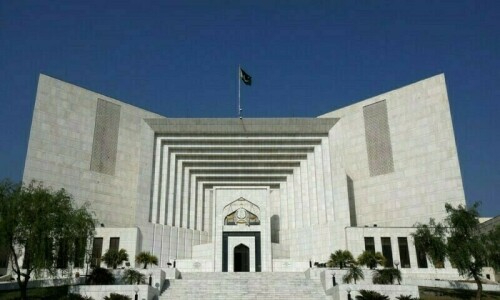
ISLAMABAD: Justice Shakeel Ahmed, a member of the five-judge Constitutional Bench of the Supreme Court hearing the seniority dispute among judges, on Monday questioned whether the law secretary was competent to clarify in the final summary on transfer that judges would not be required to take a fresh oath upon their posting to the Islamabad High Court.
“Were the real facts regarding seniority kept hidden from the chief justices during the process of consultation?” Justice Ahmed asked, expressing concern that such anomalies had led to doubts and raised questions about mala fide intent.
The five-judge CB, headed by Justice Muhammad Ali Mazhar, had taken up a joint petition filed by five IHC judges — Justices Mohsin Akhtar Kayani, Tariq Mehmood Jahangiri, Babar Sattar, Sardar Ejaz Ishaq Khan and Saman Rafat Imtiaz. The petition argues that three transferred judges should not be treated as IHC judges until they take a fresh oath under Article 194, read in conjunction with Schedule III of the Constitution.
Senior counsel Faisal Siddiqi, representing former presidents of the Islamabad High Court Bar Association, argued that the establishment of the IHC was implemented under Article 175 of the Constitution and that the appointment of its judges under the IHC Act pertained only to the provinces. Even in cases of transfer, he contended, the transfer is not permanent and there is no need for a new oath when a judge returns to his original court.
Justice Ahmed asks if chief justices were kept in dark on seniority
The counsel also asserted that the powers of the Judicial Commission of Pakistan (JCP) had been undermined in the current system of transfers, contrary to the spirit of the Constitution.
Justice Ahmed observed that a unified seniority list of judges across the country could help resolve such disputes. Mr Siddiqi agreed, saying the effects of judicial transfers would become clearer and more transparent with such a list.
Attorney General for Pakistan (AGP) Mansoor Usman Awan argued that the Third Schedule of the Constitution does not require a separate oath for IHC judges. He explained that the Constitution only refers to “high courts” for the oath, and the IHC judges had taken the same oath as those transferred from other courts.
When Justice Naeem Akhtar Afghan asked whether a new oath was needed under Article 200 in case of transfer, the AGP replied that there was no such requirement under this article.
Justice Afghan also inquired why the final summary of the judge transfers made no mention of an oath.
The AGP replied that there was an SC verdict on judges’ seniority, and the summary sent to the prime minister was administrative in nature. He explained that under Article 200, the transfer of judges can be either permanent or temporary. In cases of temporary transfer, judges receive additional benefits. In permanent transfers, they are provided with government accommodation. If the transfer is for a limited period, the judge eventually returns to their original high court.
The AGP clarified that if a judge is permanently transferred, their seat in the original high court becomes vacant. While government accommodation was provided to judges transferred to the IHC, they did not receive any additional allowances. Moreover, judges who are transferred are not required to take a new oath, he added.
Published in Dawn, May 27th, 2025