0
0
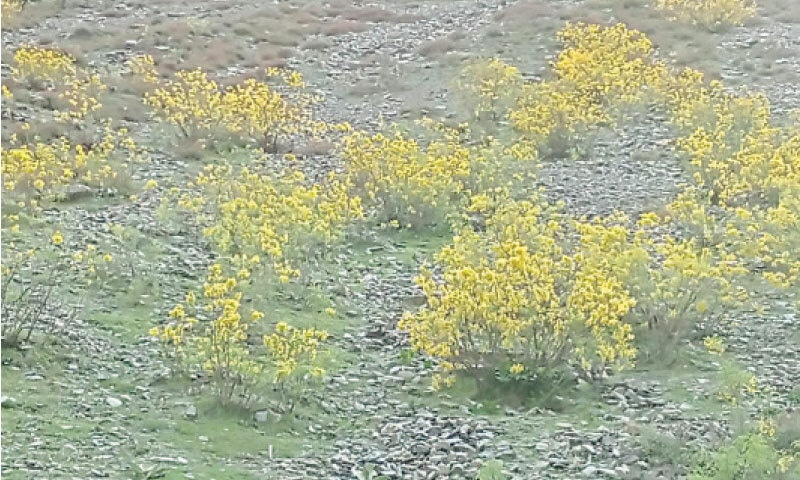

CHITRAL: The pastures and meadows, situated on the hillsides of Chitral, appear to be clad in a yellow sheet due to the blossoming of the wild plant Sophora mollis, locally known as beshu, which is endemic to the area and maintains a stable population density.
Found in abundance from the Arandu area in the extreme south of Chitral to the Broghil Valley in the north, the plant grows through seed dispersal and is known for high resilience to drought, so its population is growing fast.
This flowering shrub is regarded as a ‘sacred flower’ by the indigenous Kalash people whose primitive culture and religion are based on a unique set of dogmas. Its blossoming season coincides with the Kalash spring festival, Chilim Jusht, during which the plant is extensively used in rituals.
Ajaz Ahmad, an environmentalist associated with the local forest department, told Dawn that beshu, which was widely used throughout the Chitral Valley, thrived in rangelands.
Beshu blossoms signal spring and spirituality
He said that the plant was an integral part of the Kalash spring festival during which women and children adorned themselves with its flowers, and homes were lavishly decorated with its flowering twigs.
“The very scheduling of the festival is based on the blossoming of the plant, as some rituals cannot be performed without it,” he said.
The expert said that the dried twigs were used for fumigation inside houses year-round to ward off ‘evil souls’.
He noted that in other parts of Chitral, the shrub had diverse uses, ranging from fuel for cooking to being used as an organic fertiliser and a remedy for skin diseases.
Mr Ahmad said that before the introduction of chemical fertilisers, farmers growing paddy used the flowers and twigs of beshu as an organic alternative, serving both as a fertiliser and an insecticide.
He said the plant was a strong insect repellent; its pungent scent drove away pests, and flowering branches were waved over vegetable fields to protect young plants.
“The paste of beshu flowers is also used as a face cream and in the treatment of skin diseases such as eczema and psoriasis. It has a soothing effect when applied to internally injured parts of the body,” he said.
Discussing other benefits, he said that honey bees were drawn to the strong scent of the flowers, boosting honey production during the blooming season.
The remarkable properties of the plant even attracted the attention of Chinese rulers, who controlled Upper Chitral in the 4th-8th centuries AD.
Educationist Mukarram Shah, an authority on local history, said that when the Chinese suzerains ceded control to local rulers, they included dried beshu timber in the list, which they wanted as tributes from the state on a yearly basis.
Published in Dawn, May 5th, 2025