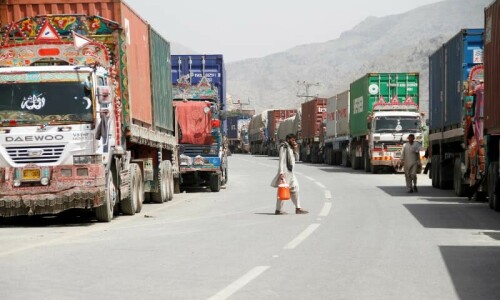
The recent escalation in hostilities between Pakistan and India has left truckers from Afghanistan in a mess.
The central leader of the Pak-Afghan Joint Chamber of Commerce and Industry (PAJCCI) on Saturday said that India has not allowed Afghan trucks carrying goods to cross the Wagah border.
Whereas, he added that Pakistan has also not permitted the vehicles carrying items imported from India under the transit agreement to enter Afghanistan via Torkham and Chaman border points.
Earlier this week, Pakistan allowed 150 stranded Afghan trucks carrying goods for India to cross the border, easing a weeks-long bottleneck. The moves came nearly a week after Pakistan shut off its borders for any trade with India, including to or from a third country, in response to New Delhi’s measures following a deadly attack in occupied Kashmir. India, without proof, implied cross-border links, which Pakistan denied and instead sought a neutral probe.
Islamabad decided to halt trade with New Delhi, including to and from any third country via Pakistan, during the National Security Committee meeting on April 24.
Speaking to Dawn.com today, PAJCCI leader Khan Jan Alokozay confirmed that despite Pakistan giving the permission, India has not allowed the trucks to cross the Wagah border.
“A total of 150 trucks had entered Pakistan and were supposed to proceed to Wagah but have been stranded after April 25.”
“These trucks are carrying dried fruit, fresh fruit and vegetables. First, Pakistan had stopped these vehicles, and now India is not giving permission,” Alokozay said from Kabul.
He said Pakistan has also stopped those Afghan commercial vehicles which carry imported items from India.
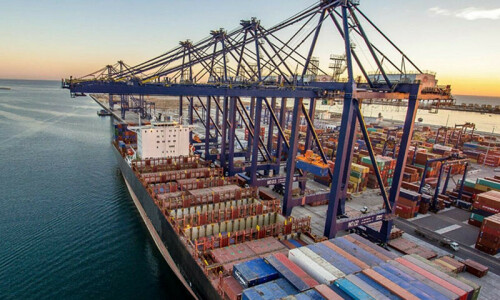
“Around 1,500 containers arrived at Karachi ports from India. Some of the goods were loaded, and containers have arrived at Torkham and Chaman. Pakistan has stopped those vehicles.”
He said that the items stopped were transit goods from India, and they wanted to take them to Kabul.
“They have been stopped and that causes losses to us,” he said.
“It is sad that this problem prevails and has not yet been resolved. We are making efforts to solve it.”
An Afghan official in Kabul said that, like Pakistan, the Indian External Affairs Ministry, in a letter, has asked the border authorities to facilitate the entry of Afghan trucks into India.
Despite permission from both Islamabad and New Delhi, the Afghan commercial trucks have not yet been allowed to enter India via Pakistan from the Attari-Wagah border, the official added.
Meanwhile, the Afghan embassy in Islamabad, quoting a trader, said that customs officials at Wagah and Chaman were not allowing the vehicles to enter Afghanistan, saying that they had not yet received instructions.
“They said neither India has given them a green signal nor Pakistan has conveyed them officially,” the trader was quoted as saying in an audio clip sent to his representatives.
Pakistan’s Foreign Ministry issued a letter dated April 30 that read, “The ministry has the honour to inform that in view of the brotherly relations between Pakistan and Afghanistan, the government of Pakistan has decided to permit stranded Afghan trucks, carrying goods in transit to India, which entered Pakistan before 25 April 2025, to cross Wagah border for delivering the goods.”
The Afghan embassy in Islamabad had sent a note to Islamabad to allow Afghan trucks stranded in Pakistan to enter India after it closed the Wagah border and suspended all trade — including transit — with the neighbouring country.
Pakistan permitted the Afghan trucks to cross the Wagah border to deliver the goods in India but they were not allowed to proceed further by the Indian authorities.
Under the Afghanistan-Pakistan Transit Trade Agreement (APTTA), the landlocked Afghanistan can use Karachi and Gwadar ports for imports and exports.
Pakistan has been facilitating Afghan transit through its ports under the APTTA signed in 1965 and revised in 2010.
The agreement expired in 2021, and both sides have now agreed to sign a revised agreement soon.