HRCP report highlights decline in civic freedoms, deteriorating law & order


 0
0
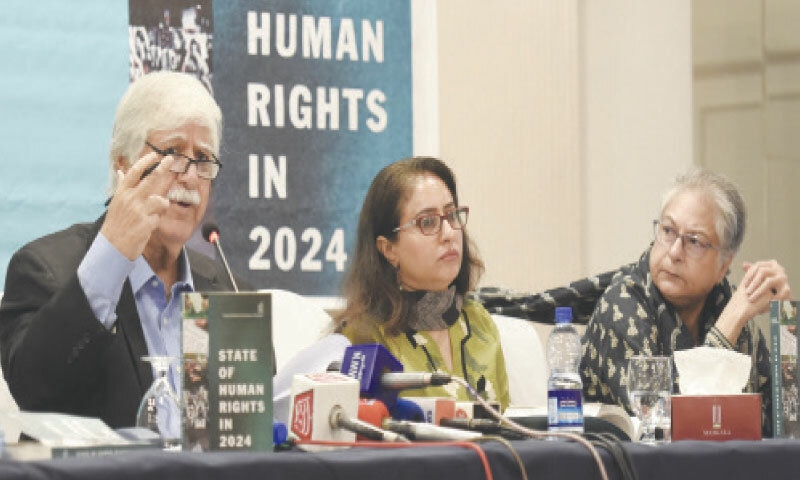

ISLAMABAD: The Human Rights Commission of Pakistan’s annual report, released on Wednesday, highlighted a troubling decline in civic freedoms, deteriorating law and order, and a marked strain on federalism.
State of Human Rights in 2024 noted that the general elections in February 2024 were compromised by allegations of electoral manipulation. Amid the ensuing political instability, the fate of a major political party and its allocation of reserved seats were left undecided.
The government that took office subsequently ceded space to undemocratic forces in the form of several hurriedly passed and flawed laws.
Of particular concern was the spike in militancy in 2024: related fatalities reportedly surged to over 2,500, with Khyber Pakhtunkhwa and Balochistan accounting for the bulk of such attacks. At least 24 deaths were attributed to vigilante mobs, some of which were linked to allegations of blasphemy in Swat and Sargodha.
Says 2024 polls compromised by poll manipulation charges; fate of major political party, allocation of its reserved seats left undecided; govt cedes space to undemocratic forces
Speaking at the launch, HRCP chairperson Asad Iqbal Butt drew attention to continued state-sanctioned violence in 2024, with at least 379 officially reported new cases of enforced disappearance, two extrajudicial killings of persons suspected of blasphemy and 4,864 staged police encounters in Sindh and Punjab alone.
Former HRCP chairperson Hina Jilani said that enforced disappearances were not justified in any circumstances, “including war or insurgency”, adding “No cause can justify violence or acts of terrorism. The human rights community insists that all acts of violence be dealt with in accordance with the law,” she said.
Over 1,200 individuals were imprisoned on charges of blasphemy, having been entrapped by far-right groups into sharing allegedly blasphemous content online. The beleaguered Ahmadiyya community reported at least six faith-based killings and the desecration of over 200 graves and worship sites. Such developments are symptomatic of escalating radicalisation and the state’s capitulation to far-right political parties.
The continued ban on social media platform X, arrests of journalists reporting on politically sensitive issues, repeated imposition of Section 144 to prevent public gatherings, the ban on the Pashtun Tahafuz Movement and the use of disproportionate — and on occasion, lethal — force against assemblies reflected a state not prepared to brook criticism or dissent.
Criticising the government’s law making in 2024 and its impact on freedom of expression, HRCP co-chair Munizae Jahangir said that public officials should not be shielded from legitimate criticism by ordinary citizens.
With 2.4 million cases pending nationwide, Pakistan’s judicial system remained heavily burdened during the year. Although at least 174 death sentences were reportedly handed down by the courts, no executions occurred. The country’s jails accounted for an overcrowding rate of almost 228 per cent.
HRCP Secretary-General Harris Khalique pointed out that miners, sanitation workers and polio workers faced heightened safety risks, with at least 172 work-related deaths in 2024 in these sectors alone. Violence against women and children remained pervasive, with at least 405 honour killings, 4,175 cases of rape, 1,641 domestic murders, and 1,630 instances of violence against children. The government continued to repatriate Afghan nationals amid concerns that such deportations did not meet international standards of consent and dignity. Education and health outcomes remained poor, while recurring extreme weather events and hazardous air quality marked parts of the year.
HRCP Islamabad vice-chair Nasreen Azhar concluded the event by expressing concern that the 26th constitutional amendment had resulted in executive overreach in the affairs of the judiciary.
Published in Dawn, May 1st, 2025