0
0

ISLAMABAD: The International Organisation for Migration (IOM) announced on Tuesday that it has now assisted more than one million Afghan migrants returning from Pakistan and Iran since the dramatic rise in Afghan return movements began in September 2023.
This announcement comes at a critical time as the Pakistan government launched the second phase of its Illegal Foreigners Repatriation Plan (IFRP), which could impact an estimated 1.6m undocumented Afghan migrants and Afghan Citizen Card (ACC) holders throughout 2025.
Since September 2023, more than 2.43m undocumented Afghan migrants have returned from Pakistan and Iran. Of those, 54 per cent were forcibly returned, according to the IOM, a UN-related intergovernmental organisation. The organisation has provided post-arrival humanitarian assistance to 1,003,563 returnees.
“Reaching the one million mark reflects the capacity of both IOM and our partner agencies, as well as our ongoing commitment to supporting Afghans returning to a country where many have little or nothing to come back to,” said IOM Afghanistan Chief of Mission, Mihyung Park.
“With a new wave of large-scale returns now underway from Pakistan, needs on the ground are rising rapidly — both at the border and in areas of return that are struggling to absorb large numbers of returnees.”
In the meantime, IOM and its partners reiterated their call for all countries to immediately halt the forced returns of Afghans until conditions are in place to ensure safe, dignified, and voluntary returns, regardless of a person’s legal status.
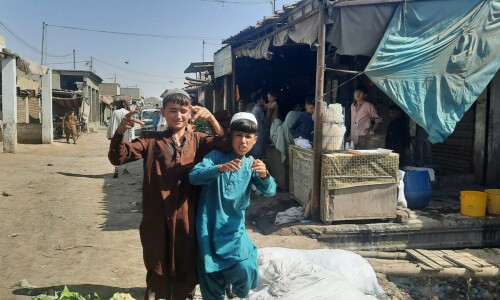
The IOM report says that between April 1 and 13, 2025, IOM recorded a sharp rise in forced returns, with nearly 60,000 individuals crossing back into Afghanistan through the Torkham and Spin Boldak border points. The IOM has assisted 10,641 of them.
Meanwhile, returns from Iran remained consistently high in late 2023 and have continued into 2024. Iranian authorities have also announced plans to escalate deportations this year.
Cumulatively, since Sept 15, 2023, a total of 854,033 individuals have returned to Afghanistan. Of these, 6pc (48,042 individuals) have returned since Jan 1, 2025. Fear of arrest (93pc) remains the key reason to return to Afghanistan, followed by communal pressure (29pc) and the deportation of a family member (18pc).
Most returnees came from Punjab (28pc), Balochistan (24pc), Sindh (21pc), and Khyber Pakhtunkhwa (20pc). A small share also came from Islamabad Capital Territory (7pc). The districts of origin in Pakistan are Karachi (20pc), Quetta (16pc), Rawalpindi (14pc) and Peshawar (12pc). Other districts only account for a small share of returnees.
In Afghanistan, most returnees go to provinces close to the border, including Kabul (20pc), Kandahar (18pc) and Nangarhar (17pc).
Published in Dawn, April 16th, 2025