NGO provides safe haven for exotic monkeys rescued by Pakistan Customs



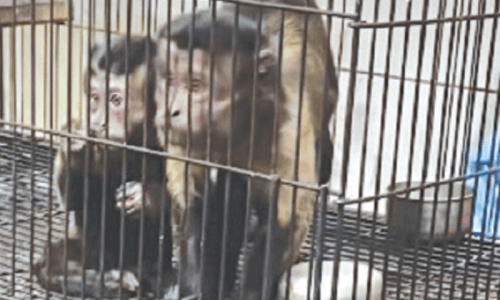
Animal rights organisation Ayesha Chundrigar Foundation (ACF) has provided a safe haven for the exotic monkeys rescued by Pakistan Customs, a press release issued by the NGO said on Friday.
Last week, an illegal consignment of 26 monkeys from South Africa, two of which died at the airport while in the custody of customs officials, was handed over to ACF for want of coordination among government departments.
Sources had said that customs staff had confiscated 26 monkeys — tufted capuchin and marmosets — in January at Karachi airport. They were being imported by M/s Khayal Enterprises on an alleged fake no-objection certificate (NOC) from South Africa.
“In a harrowing case of wildlife trafficking, Pakistan Customs recently intercepted a group of exotic monkeys who had endured unimaginable suffering during their illegal transport,” the statement by the NGO said.
“Upon rescue, these terrified animals were found in a severely traumatised state — their eyes bulging with fear, their bodies weakened by starvation, and their screams echoing the distress of days spent confined in coffin-like boxes without daylight, food, or water,” it continued.
“ACF Animal Rescue, known for its commitment to animal welfare, stepped in immediately to provide these monkeys with urgent care and a safe environment,” the statement added.
The organisation said that temporary enclosures were built overnight to ensure the monkeys’ security and comfort while work continues on a larger, more permanent sanctuary.
“The new facility, currently under construction, will provide them with the space and mental stimulation they desperately need, featuring jungle gyms, old tree trunks, and other natural elements to help them regain their physical and psychological well-being,” the statement continued.
It said that in the meantime, the monkeys have been provided with soft blankets, stuffed toys for comfort, and an abundance of nutritious food. ACF said it was also in close contact with internationally recognised wildlife sanctuaries to find them the most suitable long-term home — one that closely resembles their natural habitat.
“Given the complexity of the rehoming process, including extensive paperwork and high costs, ACF is working diligently to ensure a smooth transition. The monkeys are expected to undergo a mandatory four-month quarantine before relocation, making their current rehabilitation all the more crucial,” the statement said.
“Our goal is to give these monkeys a second chance at life in an environment where they can heal and thrive,” the statement quoted Ayesha Chundrigar, Founder of ACF Animal Rescue.
“Their suffering has been unimaginable, but we are committed to ensuring they never experience such cruelty again,” she added.
“ACF Animal Rescue calls on wildlife conservation organisations, donors, and animal lovers to support this critical mission. Those interested in contributing to the care and relocation of these monkeys can reach out to ACF for more information on how to help,” the statement concluded.
A study in 2018, compiled through undercover surveys of 55 markets in 23 cities across Pakistan, revealed that a majority of species/animal derivatives were on sale at these markets are listed within the Convention on International Trade in Endangered Species and the International Union for the Conservation of Nature’s Red List of threatened species.
The study found that Karachi hosted the highest number of markets and shops dealing in illegal wildlife, followed by Peshawar. The consumption of the dried meat of the Indian cobra and sand lizard was recorded to be widespread in Khyber Pakhtunkhwa and Punjab.