0
0

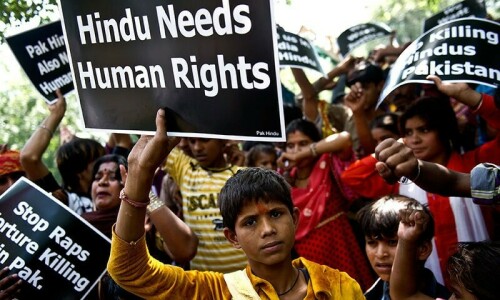
LAHORE: The Human Rights Commission of Pakistan (HRCP) said on Tuesday it had observed a growing trend of mob-led attacks on homes of families belonging to religious minorities, as well as their places of worship.
The HRCP also spoke of Ahmadis’ “arbitrary detention”, “desecration of their graves”, and the “vulnerability of Hindu and Christian women” to forced conversion.
The report, titled Under Siege: Freedom of Religion or Belief in 2023-24, said over 750 persons were in prison on charges of blasphemy, as of October last year. It documented at least four faith-based killings, three of which targeted the Ahmadi community.
A key finding of the report is that disinformation on social media was the spark behind most of the registered blasphemy cases.
Report blames disinformation on social media for Jaranwala and Sargodha incidents
Analysing two mob-led attacks against the Christian community in Jaranwala and Sargodha, the report dwells at length on the scale and frequency of social media posts that incited violence following allegations of blasphemy.
Another observation made in the report was about an “increasing weaponisation of blasphemy laws against Ahmadis”, with cases often initiated by law enforcement officials themselves.
According to the report, four FIRs were filed by police officers against Ahmadis in Punjab, reflecting an institutional bias against the community.
Authorities in Punjab and Sindh conducted mass arrests of Ahmadis under the Maintenance of Public Order Ordinance, detaining 36 individuals for observing Eidul Azha.
The HRCP report noted that the “influence of extremist groups in driving state policies against Ahmadis” was growing.
It narrates that members of the Tehreek-i-Labbaik Pakistan (TLP) played a role in filing blasphemy cases against Ahmadis, orchestrating campaigns to stop them from celebrating Eidul Azha, and even accompanying police during raids to confiscate sacrificial meat.
Videos circulating on social media show TLP activists, alongside law enforcement personnel, raiding Ahmadi households, lending credence to allegations about the complicity of state actors in religious persecution.
Desecration of graves remains a recurring violation against the community, according to the HRCP.
The report said that in 2023 and 2024, numerous Ahmadi cemeteries were attacked across Punjab and Sindh, with “police and district authorities participating” in some instances.
“A total of 42 attacks on Ahmadis’ places of worship were recorded, with nearly 60 per cent of these either conducted or supervised by law enforcement agencies,” the commission said.
The report pointed out that impunity for perpetrators of hate and violence persists.
Despite investigations by the Special Branch in Punjab, no measures have been taken against networks suspected of framing individuals in false blasphemy cases.
The report noted some positive developments, nevertheless, including occasional judicial relief to suspects and victims of faith-based violence.
Constitutional amendment proposed
The HRCP presented the report at a meeting of its National Interfaith Working Group, which was instituted as a platform for collective action and advocacy for all religious minorities and sects.
Members of the working group underlined the need to introduce procedural changes to discriminatory laws that affect religious minorities disproportionately.
They proposed a constitutional amendment to give religious minorities the right to hold the offices of president and prime minister.
Members drew the authorities’ attention to the “bigoted role of the clergy” in district peace committees, inadequate compensation for victims of mob-led attacks, and the need for a legal aid mechanism to support persons accused of blasphemy.
Another concern raised was that of large-scale religious conversions among poor communities and the lack of space for religious minorities’ graveyards.
Other recommendations included the need for pro-minority legislation to be vetted by the human rights ministry rather than the religious affairs ministry, and for religious minorities’ marriage laws to be enforced.
Members called for affirmative action to create greater political space for religious minorities, including through a minorities’ caucus in parliament.
Published in Dawn, March 5th, 2025