0
0

It is a cold December evening in the Muhajir Camp settlement of Karachi’s Baldia Town, as men of varying ages start gathering in a vast ground, some of them carrying bows and arrows.
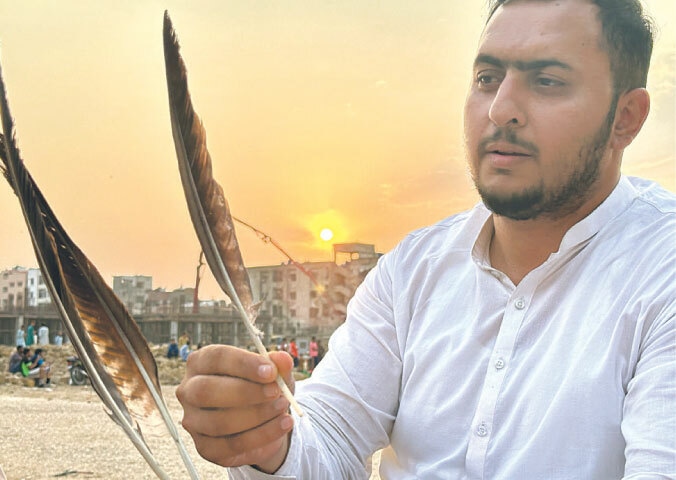
Thirty-five-year-old Muhammad Imran Yousafzai is one of them, busy marking the area. He explains to Eos that they are preparing for a tournament of Mukha, a traditional form of archery popular in parts of his native Khyber-Pakhtunkhwa (KP) province.
Imran tells Eos he has been playing Mukha since his childhood and considers it as a vital connection to his cultural heritage. “Our forefathers played the game as a symbol of tradition,” he explains. “When Pakhtun families migrated to Karachi — either for labour or business — they brought the game with them, ensuring it remained alive,” he continues.
However, despite its popularity among the Pakhtun community, the game remains relatively unknown to other ethnic groups in the city.
A sport of precision and legacy, the archery sport Mukha has long been a cultural staple in Pakhtun communities. In Karachi, with the largest urban Pakhtun population in the world, the sport persists despite the city’s challenges…
ROOTED IN HISTORY
The sport has a rich history. According to Pakhtun elders, the game has been played for hundreds of years, and traces its origins to Turkey, before it travelled through Saudi Arabia and eventually to KP.
Sardar Ali, a 65-year-old Mukha enthusiast, reflects on the significance of the game. “I played this game as a young man in KP and Quetta. Today, my children and grandchildren continue this tradition, keeping our culture alive,” he tells Eos.
Traditionally, the game was played during the winter months, often after the harvest season. However, in Karachi, Mukha is turning into a year-round activity, due to its large Pakhtun population.
Historically, the game has been popular among Pakhtun villagers, especially farmers, who played it for entertainment after a hard day’s work. It was also a way to sharpen archery skills, which were once essential for hunting and self-defence. Over time, Mukha became a social activity, often played at village gatherings, festivals and special occasions, bringing communities together through friendly competition.
HOW IT IS PLAYED
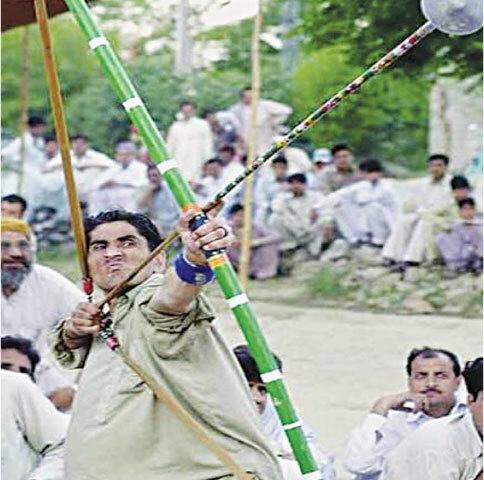
Mukha involves using a long wooden bow (leenda) to shoot long arrows (ghashay) at a tiny target, which can range from a saucer-shaped metallic plate (tubray) to a wooden peg. The target is placed several metres away, against a temporary wall constructed from mud and cement within the playing ground.
The game is played in teams. Each team consists of 12 players, of which eight are active players and four substitutes to replace injured or unwell members. The game comprises two rounds, with each team attempting 16 targets per round.
To win, a team must score at least 16 successful hits out of 32 attempts, while the opposing team must fall short. The challenge lies in hitting the small target from a considerable distance, ranging between 50 to 100 feet (15 to 30 metres).
Another competitor, 38-year-old Jahangir Khan, explains that Mukha is not for everyone, as it requires a calm mind, proper technique, and even a “strong chest” for precise targeting. “Many try but fail because they lack the necessary skills,” he says.
Jahangir adds that the game is yet to find favour among Pakhtun women in Karachi. “However, there are three teams of female Mukha players in Peshawar, who are very active,” he says, before adding that tribal conservatism and the difficulty level of the game is also a deterrent.
AGAINST THE ODDS
In KP, most Mukha practitioners had vast open fields to practice. In Karachi, though, they do not have that luxury.
Most tournaments take place in open grounds, that are alongside main roads, with their usual traffic and commuters. More often than not, says one of the participants, the tournament takes place with children also using different parts of the ground.
This poses a serious risk, as arrows aimed at small targets could accidentally injure passing travellers, including motorcyclists and pedestrians. Unfortunately, there are no protective walls or safety barriers to prevent such accidents.
Despite this, players claim that they have been playing Mukha for many years without any major incidents. They emphasise that they are skilled in the techniques of the game and do not misfire.
However, the playground where the tournament is taking place lacks basic facilities, such as seating arrangements, proper lighting and access to drinking water. Players and organisers bear the responsibility of arranging chairs, cleaning the ground, installing sound systems, and providing water and lights.
The sport also lacks official patronage of any sort, with participants paying from their own pocket to organise tournaments, which often sees the participation of more than two dozen teams.
Jahangir explains that when a team wins a tournament, it becomes responsible for organising the next event in its area. “The winning team also collects funds for prizes, which range from 10,000 to 20,000 rupees,” he tells Eos.
As a large number of participants and onlookers point out, there is a need or a dedicated space for this sport, with safety measures.
Imran, who led the preparation for the tournament, urges the government to support them by building a proper playing field and constructing safety walls at the current roadside locations. He also appeals for assistance in organising tournaments in various cities. “This support will enable us to participate in national and international competitions and make Pakistan proud,” he says.
For Pakhtuns, Mukha is more than just a sport — it is a symbol of their history, resilience and camaraderie. Even as modern games dominate the sporting landscape, Mukha remains a cherished traditional activity that showcases the Pakhtun people’s deep connection with archery and their love for competitive sports.
The writer is a freelance journalist from Umerkot, Sindh, and is currently based in Karachi.
X: @Pawanjourno
Published in Dawn, EOS, February 23rd, 2025