0
0

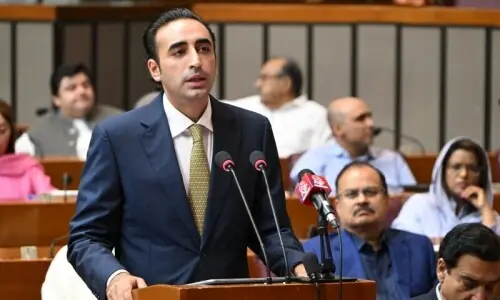
ISLAMABAD: While state-owned power distribution companies have sought an over 400 per cent increase in security deposits from consumers, two federal ministers advocated for cheaper electricity rates for industrial consumers and the rationalisation of the ‘disproportionate tax burden’ on the salaried class in the coming months.
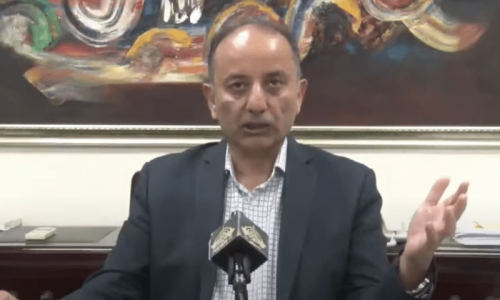
At an event organised by the Pakistan Business Council, Finance Minister Muhammad Aurangzeb was of the opinion that the salaried class in the country was facing a “disproportionately high tax burden” that should be eased. He was uncertain about potential changes to tax slabs in the upcoming budget due to the ongoing programme with the IMF. However, he assured that the tax filing system for salaried individuals would be simplified, reducing the need for tax consultants and advisers.
The finance minister noted that he expected the policy rate to decrease further as inflation continued to fall. He said large businesses were borrowing at interest rates under 11pc, and foreign exchange reserves had improved to $13 billion, sufficient to cover almost three months of imports — key for improving Pakistan’s credit rating.
He said the budget process had already begun in January and he would be interacting with all sectors, including chambers and trade bodies, next month. Despite this, he emphasised that Pakistan was under a three-year IMF programme, managing business expectations, and reaffirming the government’s commitment to its obligations with international lenders.
Power companies seek 400pc hike in consumers’ security deposits
The minister said the revenue policy role would be shifted to a unit within the Ministry of Finance so that the FBR could focus on revenue collection. He assured that while the government would facilitate retailers and businesses, it would not compromise on due taxes. He claimed that all economic indicators were moving in the right direction.
Power Minister Awais Ahmad Khan Leghari addressed a long list of power projects that had been committed in violation of the least-cost principle, saying that many of these projects would be scrapped if they had not achieved financial closure. By April, the Central Power Purchasing Agency would stop purchasing electricity from new plants, and surplus capacity would be auctioned off.
Mr Leghari said the government would offer electricity to industrial consumers at marginal cost and was considering even cheaper rates for Greenfield projects, especially data centres and IT businesses. He added that the competitive electricity market would be fully operational in two to three years, with gradual implementation starting in April.
He said the government was reviewing tariff structures for nuclear power plants, Wapda’s hydropower plants, and other public-sector projects, as well as Chinese power producers, in an effort to address circular debt and reduce electricity rates sustainably.
Mr Leghari noted that industrial tariffs had already dropped by Rs11 per unit since June 2024. Furthermore, talks were underway on re-profiling Chinese power debt and nationalising debt related to nuclear power plants.
The minister said a uniform electricity tariff for the entire country was not acceptable or feasible, especially as the government moved toward privatisation. He said that while the deadlines for the privatisation of distribution companies would be kept realistic, eight out of 10 Discos would be in private hands within two-three years.
He said the government would soon begin talks with the provinces and other stakeholders to phase out the uniform tariff, adding that K-Electric would have been in a much better position without a uniform rate.
400pc increase in security deposits
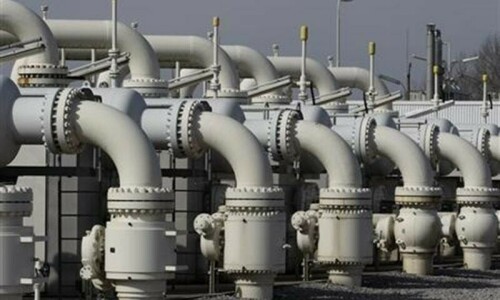
Meanwhile, power distribution companies, with approval from the power minister, submitted formal applications to the National Electric Power Regulatory Authority (Nepra) for up to a 400oc increase in security deposits for electricity consumers in lower slabs.
They proposed fixing the security deposit at 1pc of the value of assets for houses above 10-marla, and for commercial and industrial consumers. The companies argued that electricity rates had increased by 295pc since 2008, and the increase in security deposits was necessary to safeguard against defaults in consumer bills. They suggested that the security deposit should be equal to 2.5 months of electricity bills, which would raise the per kilowatt deposit from Rs1,220 to Rs5,179, or Rs15,538 for three or 2.5 months’ coverage for homes under 10-marla.
Similar rates were proposed for higher consumer categories, and the deposit would be equal to 1pc of land value, as determined by the FBR. These new rates would apply to new connections, reconnections, changes in sanctioned load, and changes in name or tariff category. The rates would come into effect after approval from Nepra.
Published in Dawn, January 29th, 2025