Nasa probe makes historic fly-by closer to Sun



• Parker unlocks key mysteries of the solar wind and corona
• No human-made object has ever passed this close to a star
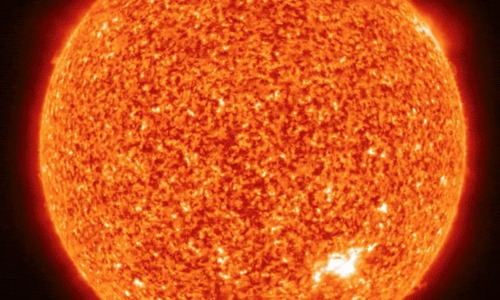
WASHINGTON: Nasa’s pioneering Parker Solar Probe made history on Tuesday, flying closer to the Sun than any other spacecraft with its heat shield exposed to scorching temperatures of more than 1,700 degrees Fahrenheit (930 degrees Celsius).
Launched in August 2018, the spaceship is on a seven-year mission to deepen scientific understanding of our star and help forecast space-weather events that can affect life on Earth.
Tuesday’s historic fly-by should have occurred at precisely 6:53am (1153 GMT), although mission scientists will have to wait until Friday for confirmation as they lose contact with the craft for several days due to its proximity to the Sun.
If the distance between Earth and the Sun is equivalent to the length of an American football field, the spacecraft should have been about four yards (metres) from the end zone at the moment of closest approach — known as perihelion.
“This is one example of Nasa’s bold missions, doing something that no one else has ever done before to answer longstanding questions about our universe,” Arik Posner, Parker Solar Probe programme scientist, said in a statement on Monday. “We can’t wait to receive that first status update from the spacecraft and start receiving the science data in the coming weeks.”
So effective is the heat shield, that the probe’s internal instruments remain near room temperature — around 85F (29C) — as it explores the Sun’s outer atmosphere, called the corona.
Parker will also be moving at a blistering pace of around 430,000mph (690,000kph), fast enough to fly from the US capital Washington to Tokyo in under a minute.
“No human-made object has ever passed this close to a star, so Parker will truly be returning data from uncharted territory,” said Nick Pinkine, mission operations manager at the Johns Hopkins Applied Physics Laboratory (APL) in Laurel, Maryland.
“We’re excited to hear back from the spacecraft when it swings back around the Sun.” By venturing into these extreme conditions, Parker has been helping scientists tackle some of the Sun’s biggest mysteries: how the solar wind originates, why the corona is hotter than the surface below, and how coronal mass ejections — massive clouds of plasma that hurl through space — are formed.
Published in Dawn, December 25th, 2024