• Petroleum minister criticises IMF deals as ‘against national interest, economic viability’
• Says fighting case with Fund, other lenders not to disconnect gas to captive plants
ISLAMABAD: Amid protests by the Pakistan Peoples Party (PPP), the government on Friday sought the support of coalition partners and opposition members to implement a weighted average cost of gas (WACOG) pricing mechanism.
This policy would integrate prices from all three sources — imports, pipeline supplies and wellhead production — to address the country’s growing gas crisis.
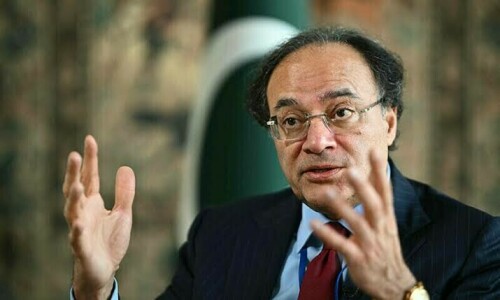
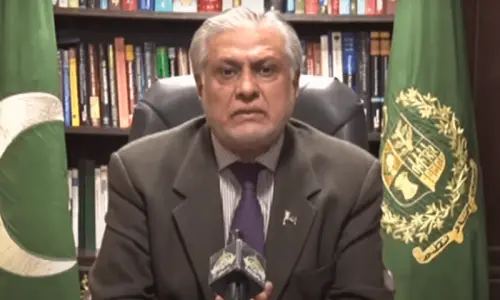
In a policy statement on the floor of the National Assembly, Petroleum Minister Dr Musadik Malik blamed the caretaker government, led by Anwaarul Haq Kakar, for tying its hands in sovereign agreements with the IMF that mandated the termination of gas supplies to industrial captive power plants (CCPs). He described the agreements as “against the national interests, economic viability and even accounting considerations”.
Mr Malik was responding to concerns raised by senior PPP parliamentarian Syed Naveed Qamar over the gas crisis.
Interestingly, the caretaker energy minister, Muhammad Ali, continues to be the cabinet colleague of the incumbent petroleum minister in Shehbaz Sharif’s government.
Even strangely, the previous nine-month Standby Arrangement (SBA) was negotiated and signed by Deputy Prime Minister Ishaq Dar in June 2023 while the ongoing Extended Fund Facility was negotiated and signed by Finance Minister Muhammad Aurangzeb.
On a calling-attention notice, Mr Qamar raised a “matter of grave public concern” that the government was curtailing the production of cheaper domestic gas while importing much more expensive LNG and simultaneously curtailing gas to industrial captive plants, further suppressing the demand.
In veiled disapproval of the policy of the PML-N’s previous government when Shahid Khaqan Abbasi was the petroleum minister, Dr Malik said the LNG imports were taking place under long-term contracts and the country had now surplus LNG because of its higher price that had no buyer at present.
Originally, at the time of term contracts, the government believed that 600 million cubic feet per day (mmcfd) of LNG would be consumed in power plants, and its price was ringfenced without a uniform price for all gas sources as if this is not gas but something else.
The minister explained that LNG now costs Rs3,600 per unit, compared to pipeline gas at Rs1,200–1,400 and wellhead gas at Rs600–700 per unit. This pricing disparity has left surplus LNG with no buyers, as the power sector is only consuming 250 mmcfd of the 600 mmcfd initially projected.
He said that in order to deal with the LNG surplus, Pakistan had shifted five cargoes originally meant for the current year to the next year, and talks were in progress with another long-term supplier to defer another five cargoes.
Despite these measures, Dr Malik warned of an anticipated gas shortage in January, noting that a request for additional cargo from Qatar had been declined. The government has floated a tender in the spot market to secure emergency supplies.
The minister said that he was the original torchbearer of the campaign against gas supply to captive power plants on the grounds that only 18 out of 2,000 or 2,500 industrial units in Karachi had a gas supply for captive power.
This meant that a few large industries had electricity at Rs13 per unit, and all other small industrial units were getting electricity from K-Electric at Rs60 per unit, and both categories were producing cotton yarn and cloth. “Small enterprises did not have a chance in hell to compete with those” 18 industries, he said.
Dr Malik defended the government’s decision to increase gas prices for CPPs to create a level playing field. However, he opposed the IMF-mandated disconnection of gas supplies to CPPs, which is set to take effect next month.
“You are replacing efficient use of gas with the inefficient use of gas,” he said, adding that his ministry was fighting a strong case with the IMF to avoid closure of gas to CPPs and hopefully would be able to succeed, but as of now, it was contractually binding.
The policy statement did not satisfy Mr Qamar, who accused the government of prioritising IMF conditions over national interests and ignoring cheaper domestic gas resources.
PPP’s Shazia Marri reminded the petroleum minister about Article 158 of the Constitution, which promises preferential gas supply to the provinces where it was produced. She condemned the “ridiculous idea” of mixing gas prices of imported and local gas.
Published in Dawn, December 14th, 2024