• Council reviews letter complaining of spy agencies’ interference, written by six IHC judges
• Addresses 10 complaints against judges, finds no substantial evidence
• Decides to hold monthly meetings to address pending plaints against judges
• JCP endorses proposal to nominate all SHC judges for constitutional benches
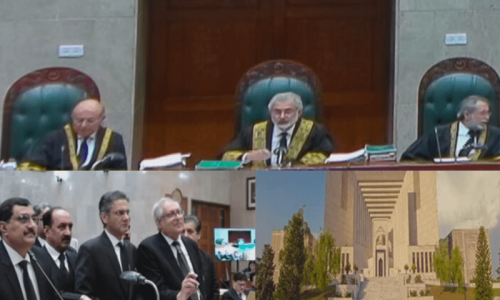
ISLAMABAD: The Supreme Judicial Council (SJC) on Friday reviewed the March 25 letter from six Islamabad High Court (IHC) judges, in which serious allegations were raised regarding interference by intelligence agencies in judicial affairs, calling for a thorough investigation.
The SJC, chaired by Chief Justice of Pakistan (CJP) Yahya Afridi, who also heads the council, considered different options concerning the letter and agreed to expand consultations, noting that the code of conduct of judges applies to heads of different institutions as well as judges.
The council also decided to revisit the matter at the next meeting and will now hold regular monthly sessions to clear the backlog of outstanding complaints against superior court judges on fast track.
The SJC meeting, which began at 11am, was attended by senior puisne judge Justice Syed Mansoor Ali Shah, Justice Munib Akhtar, IHC Chief Justice Aamer Farooq, and Chief Justice of Balochistan High Court Justice Muhammad Hashim Kakar.
The letter in question had previously prompted former CJP Qazi Faez Isa to initiate suo motu proceedings after former CJP Tassaduq Hussain Jillani declined to head a one-man inquiry commission investigating allegations of intelligence interference by the six judges.
Ever since the letter had surfaced, there were widespread calls from different circles that the apex court should take suo motu notice of the issue.
However, CJP Afridi, when he was a Supreme Court judge, had recused himself from hearing the suo motu case, arguing that inaction by the chief justice or judges of the IHC should not lead the Supreme Court to impose its jurisdiction under Article 184(3) of the Constitution.
“This may affect the functioning of the worthy chief justice and judges in their discharge of judicial functions and would amount to interference in the independence of the high courts,” Justice Afridi suggested at the time.
He stressed that high courts are constitutionally independent bodies responsible for managing their administrative functions and protecting judicial officers.
10 cases against judges reviewed
Meanwhile, the SJC, which has received over 100 complaints against superior court judges, reviewed 10 cases on Friday under Article 209 of the Constitution.
While the council’s official announcement did not specify which judges were involved, sources revealed that some complaints concerned Supreme Court judges, some now retired, although none pertained to the IHC.
The council noted that no substantial evidence had been provided in these complaints and warned that action could be taken against those filing frivolous complaints.
The council also considered different agenda items, including the establishment of SJC’s Secretariat and the formulation of council rules. A proposal from the registrar to initiate rule-making was approved, with a draft expected at the next meeting.
Furthermore, the council authorised the chairman — the CJP — to hire a competent individual as secretary for a three-month term to assist in council meetings, rule-making and setting up the council’s infrastructure and human resources.
The agenda also included discussions on amending the judges’ code of conduct under Article 209(8) of the Constitution.
SHC constitutional bench
Meanwhile, a second meeting of the Judicial Commission of Pakistan (JCP) constituted under the 26th Constitutional Amendment was also held in the Supreme Court.
Presided over by CJP Afridi, also the JCP’s chairman, the commission considered a single-point agenda to form a constitutional bench within the Sindh High Court (SHC).
Following an extensive exchange of views, the commission unanimously endorsed the proposal put forth by SHC Chief Justice Muhammad Shafi Siddiqui that all the existing high court judges were nominated to be the judges of constitutional benches to clear the backlog of cases.
This arrangement will remain effective until Nov 24 and the matter will again be taken by the commission the next day.
The meeting was attended by Supreme Court justices Syed Mansoor Ali Shah, Munib Akhtar, Aminud Din Khan and Jamal Khan Mandokhail (via a video link); SHC Chief Justice Siddiqui; Law Minister Azam Nazeer Tarar; Attorney General Mansoor Usman Awan; senators Farooq Naek and Syed Shibli Faraz; MNAs Sheikh Aftab Ahmad and Omar Ayub Khan; Sindh Law Minister Ziaul Hassan Lanjar; and Sindh Bar Council member Qurban Ali Malano.
Pakistan Bar Council representative Akhtar Hussain was unable to attend due to personal commitments.
Published in Dawn, November 9th, 2024