SHC declares cancellation of IHC Judge Jahangiri’s law degree by KU ‘null and void’


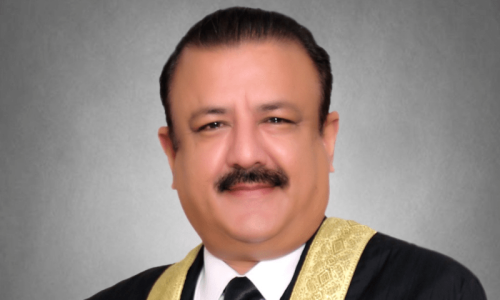
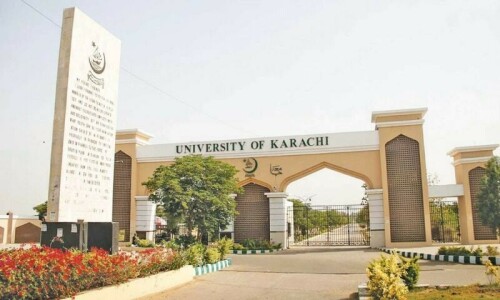
The Sindh High Court (SHC) on Thursday suspended Karachi University’s (KU) decision to revoke the law degree of Justice Tariq Mehmood Jahangiri, ruling in his favour as the court found that the university’s syndicate had taken the action in his absence depriving him of the opportunity to defend himself.
In its written order, the court ruled that the degree of the Islamabad High Court (IHC) judge was cancelled by KU’s Syndicate and Unfair Means Committee during a meeting where the judge was not present, stating that it was a “violation of Article 10-A of the Constitution” (the right to a fair trial).
“Unfortunately, no opportunity of hearing was extended to Mr Justice Tariq Mahmood Jehangiri and the manner so adopted appears to be highly objectionable, illegal … and without lawful authority,” the court ruled.
The controversy erupted in July when a letter began circulating on social media purportedly from the KU controller of examinations regarding Justice Jahangiri’s law degree.
Last week, the issue resurfaced when the KU syndicate cancelled the degree and enrolment of Jahangiri, who obtained his LLB degree in 1991 under enrolment number 5968.
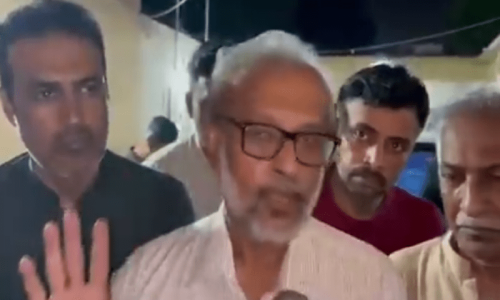
The decision came a few hours after the detention of academic and syndicate member Dr Riaz Ahmed, who was picked up by police in what appeared to be an attempt to stop him from attending the key meeting. He was released in the evening only after the syndicate decided to cancel the degree.
The petition filed with the SHC, a copy of which is available with Dawn.com, argued that Justice Jahangiri was “singularly targeted, with extreme mala fide intention, according to a premeditated and conceived plan to tarnish the reputation and destroy the reputation of the honourable judge of the Islamabad High Court”.
It added that Jahangiri “was one out of the six honourable judges of the IHC who in their letter dated 25.03.2024 informed the honourable chief justice of Pakistan about the alleged interference by intelligence operatives in judicial matters”.
The petition also argued that Jahangiri was absent at the syndicate meeting and not called in person nor provided representation, thus making the decision to cancel the degree illegal.
Jahangiri’s counsel argued that KU’s Unfair Means Committee was “formed illegally and not in accordance with the Rules of Respondent No.4, therefore at the very inception the formation was void, illegal and illicit”, rendering any of its recommendations void and illegal.
The court ruled that the degree was cancelled “without hearing and by violating the basic settled principle of law”, adding that the petitioners’ claims “carry substantial weight”.
As Justice Jahangiri was not present at the syndicate’s meeting, he was “condemned unheard” and the decision was “null and void.”
The court added that under Article 199 (the jurisdiction of the High Court), it has the power to order any institution to “refrain from doing anything that is not permitted by law to do”. It ordered KU against taking “any coercive measures based on these decisions” until the date of the next hearing.
The SHC ordered that notices be dispatched to all respondents, including the Sindh attorney general, requesting responses within three weeks.
The hearing
A two-member bench, comprising SHC Justices Salahuddin Panhwar and Justice Amjad Ali Sahito, heard the case today.
“Whose degree is it?” Justice Panhwar asked. “How many decisions of this nature has the university made?”
The advocate responded by stating that KU had acted in a “non-transparent manner”.
When asked by the judge about when the degree was awarded, he replied that it was conferred 30 years ago.
Justice Panhwar asked, “On whose request has all this happened? On whose complaint has action been taken? The letter was sent by the Islamia Law College,” he added.
Asked by Justice Sahito about the relation of the petitioners to the case, the advocates responded that it had been filed by lawyers and added that KU does not have the authority to make such decisions.
“Only the Judicial Commission can make such decisions,” the advocate stated.
One of the advocates spoke about the detention of Dr Riaz Ahmed, upon which Justice Sahito told them, “Do not talk about politics here.”
He added that if someone’s degree was being cancelled, then “he should be called and given notice”.