0
0

 THE economy of Tharparkar is known to be based on livestock farming and rain-dependent agriculture. However, the poorest segments of Thari society who own neither livestock nor land to farm, survive on credit and casual labour where they can get it.
Some turn to labour opportunities created by natural resources such as the coalfield, natural salt lakes and china clay mines, exposing themselves to constant health hazards for a pittance (see separate story). Others work in carpet weaving. And others still pursue a few rupees a day wherever they can find them.
For women, this is often the production of ancient traditional handicrafts like handheld fans made from peacock feathers or embroidered caps. For men, it can be the laborious production of unfiltered cigarettes and for families all together it’s often work on road construction.
All these forms of labour come with their own problems and difficulties but they’re all tied together by the common thread of exploitation.
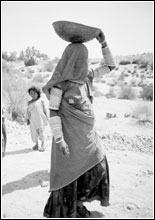
Road workers: The road that leads out of the district headquarters of Mithi south westwards towards the Taluka of Diplo is being worked by a dozen men, women and children. The mid-afternoon heat is intense. Two men unload a truck of stone. The women, their veils pulled down low over their faces, transport huge iron bowls full of stone from one end of the road to the other. Girls of seven or eight help, struggling with the weight of the stones, walking over the hot bed of rocks barefoot.
Bharu is a father of five and has trekked the 250 kilometers from the easterly Taluka of Nagarparkar by foot with his entire family. Now, they’re all working on the road. “We didn’t know where we were going when we left home two months ago,” he says. “The drought sent us away from home.”
The construction of roads has taken place at a rapid pace in Tharparkar over the last few years. The 2005-06 development budget for Sindh is littered with planned spending on a variety of roads throughout the district. Major towns have been connected by roads, making communications easier and travel distances shorter.
The construction has also created some scattered opportunities for casual labour. But their conditions remain dire. Bharu and his family camped in the desert on their journey to town and continue to live in the desert, sleeping on a few ragged sheets they brought along. They live out in the open without even the mud plastered huts they have at home. Each worker gets two rupees for each foot of road they pave. On average, a worker can pave 50 feet a day if they work several hours late into the night, often working 18 hours a day.
Lakhma, a mother of four is also working alongside Bharu and his family. “Look at my hands,” she says holding out her weathered palms. “My back hurts, my bones hurt, my hands hurt,” she says. “But what can I do? If we don’t do this, we will starve to death. We do this for the cursed stomach.” She slaps her hand repeatedly on her abdomen and shrieks in frustration.
The workers turn their attention back to the road. And their thoughts back to dreams of rain which will pave the way back home. They’ll still labour there, working on the agriculture land of others. But at least it will be home.
Handicrafts: Generation after generation, women all across Thar learn from a young age the intricate embroidery particular to their region. Whether it’s the production of their heavily embroidered shirts, delicately patterned caps or laboriously produced wall hangings depicting the camel and the peacock, women in Thar spend several hours a day with the thread and needle.
Part of this is tradition, and part is pure economics. Without the tiny additional income they make from selling these handicrafts, it is hard to make ends meet. The demand for these products is substantial. That’s why most of them sell for high prices even in the town of Mithi, let alone the exorbitant rates in cities like Hyderabad and Karachi. However, without access to a market, the poverty of these women continues to be exploited by middle men and wholesalers who pay them as little as five rupees a day and accumulate fat profit margins themselves.
Sometimes, with the right mix of components, better-off families can make a decent living. In the village of Veri Jhap in the Taluka of Diplo, for example, Gajjo’s family has been making shawls on handlooms for more than a century. His relative affluence is apparent. His house is cemented, elaborately decorated on the outside with colourful depictions of flowers and peacocks, and inside are stacks of steel trunks, piles of linen, plastic chairs and a tape recorder, not common sights in rural Thar. He owns ten handlooms and says one produces an average of 20 shawls a month which sell for Rs 4,000 each.
His boys sit at the handlooms, their legs dangling down into a pit in the ground and work the brightly coloured threads at great speed. The entire family is involved in the trade. The women and spin the yarn onto wooden spindles and Gajjo himself prepares the handloom for weaving. He also sells the shawls in Mithi and is working on a plan to directly sell to the big cities beyond Tharparkar. “These people have the skills, the access to capital and are now figuring out the access to market as well,” says Salim Junejo, a Thardeep official in Mithi.
But this is a rare case. Mostly the production of handicrafts is a dire story. In Qasbo, a southern village in the Taluka of Nagarparkar, for example, women produce handheld fans made from peacock feathers and elaborately decorated with sequins and embellishments. They can produce one fan in a full day of work but rarely get more than Rs 30 for each. Stores just a few kilometers from the village sell the fans at a minimum of Rs 150 each.
Young girls are the most heavily exploited. Middle men often seek out girls from the poorest, most marginalized families trapped in the grip of poverty. In the village of Godhiar in Taluka Mithi, for example, Namuri, a girl of 14 embroiders caps and cushion covers for five rupees a day. Her younger brother of nine works for a carpet entrepreneur for ten or fifteen rupees a day working off a debt his father took several years ago.
Likewise, in Kagia village near the town of Chachro, women are heavily involved in the production of hand-embroidered caps. One cap typically takes 15 days to complete and brings them Rs 150.
Biri Making: The legendary Marvi Jo Goth in the Taluka of Nagarparkar is known for more than the tale of Marvi, a local girl who was kidnapped by King Umer Soomro in the fourteenth century and held captive in his fort in Umerkot. As the legend goes, she refused to marry him despite all manner of material temptations and longed to return to her homeland instead. She was eventually freed and the well from which she was kidnapped still stands in the village today.
Not too far from it, in the village named after Marvi, Khaskheli Muslims are involved in the labour of producing unfiltered hand-rolled cigarettes, or biris. Babbar has been doing this work for 20 years since he was just 12. He sits hunched in a darkened hut with a bowl at his feet. The bowl has a stack of leaves, a pile of tobacco and a bundle of bright purple thread with which the biris are held together. Babbar gets the leaves from his boss who buys them from Hyderabad. He first crushes the tobacco with his hands before sitting down to roll the biris. He typically rolls 800 biris in a full day’s work. He’s paid Rs 50 per 1,000 biris he rolls. His fingers are stained a now-permanent brown and his palms are hard with callouses. He also has a permanent cough, laboured breathing and perpetual sneezing from the hours spent working with raw tobacco. “My hands used to itch all the time when I was a boy but now I don’t even feel the itching anymore,” he says.
Babbar works for Ghulam Mohammed, a fellow villager who sells the biris for five rupees each to retailers who sells them onwards for seven rupees each. Babbar gets just five paisas per biri he rolls. Ghulam Mohammed has five workers in the village and says he usually sells biris in bundles of 1000 for Rs 250. —N.M.