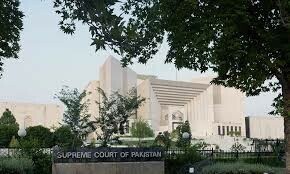
ISLAMABAD: Inordinate delay by judges in issuing written orders has caught the chief justice’s attention, prompting him to advise his colleagues to deliver judgements in “reasonable time”.
In his additional note which accompanied a written order on Thursday, Chief Justice of Pakistan (CJP) Qazi Faez Isa said judges must be “beyond reproach” in their work ethics and highlighted that as per the law and good practice, written orders should be issued soon after the hearing ends.
The 16-page order, authored by Justice Athar Minallah, explained the reasons for setting aside a Sindh High Court (SHC) order of June 2013 declaring Section 3A of the Federal Excise Act, 2005 illegal.
The CJP noted that the case was heard on Dec 6, 2023, and on the same day it was marked to Justice Minallah for writing the judgement. But he took 223 days to do so. He noted that Justice Minallah sent him the judgement on July 18, and the very next day, he wrote and signed his note.
He mentioned Order XX Rule 1(2) of the Code of Civil Procedure, 1908 — which outlines procedures to decide civil cases — prescribes that judgments should be written within 30 days.
The CJP noted that a “substantial amount” of taxpayers’ money is spent on the court, and therefore, judges must try to decide cases “assiduously and diligently”.
The CJP also cited the court’s past judgements, which stated that if there is a considerable delay in issuing written orders, the judges will not be able to recall the arguments made during the hearing.
The order
Justice Minallah was part of a three-judge bench, including CJP Isa and Justice Aminud Din Khan, who decided a case in which two high courts issued contrasting orders on a similar matter.
The dispute was over Section 3A of the Federal Excise Act 2005, which was added in June 2007. It empowered the government to collect levy and impose special excise duty on goods manufactured in Pakistan and imported into the country.
Subsequently, the federal government issued a notification on June 29, 2007, specifying the goods on which the levy and special excise duty would be charged.
The notification was challenged before the Lahore High Court (LHC) by several petitioners. However, the petitions were dismissed in May 2011 and so were the following intra- court appeals. The judgement was then challenged before the Supreme Court where a three-judge bench dismissed the petitions in Oct 2011.
Despite the LHC deciding the case and the Supreme Court upholding its verdict, the Sindh High Court (SHC) heard a petition on the same issue and struck down the notification after calling it illegal.
Justice Minallah noted that LHC’s decision on the matter was upheld by the SC and thus, it became binding on other courts. The SHC therefore, could not have decided the matter.
Published in Dawn, July 26th, 2024