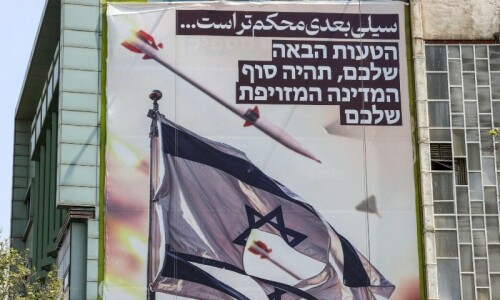
JERUSALEM: Israel and Iran traded threats on Tuesday after Tehran’s first-ever direct attack on its arch-foe sharply heightened regional tensions as the Gaza war ground on with no truce in sight.
Israeli military spokesman Rear Admiral Daniel Hagari said Iran would not get off “scot-free” after Iran launched a barrage of over 300 missiles, drones and rockets at Israel at the weekend.
“We cannot stand still from this kind of aggression,” Hagari said, a day after Israel’s military chief vowed there would be “a response” to Iran’s offensive.
Iran said its attack was an act of self-defence following a deadly Israeli air strike on its consulate in Syria and that it would consider the matter “concluded” unless Israel retaliated.
Putin, Erdogan join list of world leaders calling for restraint; US warns of further sanctions on Tehran
Iran’s President Ebrahim Raisi warned that “the slightest action against Iran’s interests will definitely be met with a severe, extensive and painful response”.
Israel weighs options
Israel was weighing its options after the Iranian drone and missile onslaught, which caused little damage as Israeli defences intercepted most projectiles, helped by US, British and French forces, as well as regional allies.
It remained unclear when Israel might strike and whether it would target Iran directly or attack its interests or allies abroad, including in Lebanon, Syria, Iraq and Yemen.
Israel made its first official comment on Monday on the strike that levelled a five-storey Iranian consulate building on April 1, killing seven Iranian Revolutionary Guards, including two generals.
“These were people who engaged in terrorism against the State of Israel,” Hagari said.
Calls for restraint
Meanwhile, world leaders have urged restraint and de-escalation.
During a phone call with Raisi, Russian President Vladimir Putin called on both sides to “show reasonable restraint and prevent a new round of confrontation,” the Kremlin said in a readout of the call.
He warned that further escalation in the Middle East could have “catastrophic consequences”.
Turkish President Tayyip Erdogan said on Tuesday that Israel’s Netanyahu and the Israeli leadership are solely responsible for the recent escalation of tensions.
“Israel is trying to provoke a regional conflict, and its attack on Iran’s embassy in Damascus was the last drop,” he told a press conference in Ankara after a cabinet meeting.
He added that new regional conflicts were possible as long as the “cruelty and genocide” in Gaza continued, and called on all parties to act with common sense.
In a statement, Portugal’s foreign ministry also urged de-escalation in the Middle East.
A day ago, US President Joe Biden stressed that “the United States is committed to Israel’s security” and wants to prevent the conflict from spreading.
Washington, Israel’s top ally and arms supplier, has made clear it will not join Israel in any attack on their common adversary Iran, a senior US official said.
More sanctions
Israeli Foreign Minister Israel Katz called on 32 countries to impose sanctions on Iran’s Islamic Revolutionary Guard Corps and their missile programme.
German Foreign Minister Annalena Baerbock, who will head to Israel on Tuesday, urged the European Union to impose sanctions on Iranian drone technology.
“I campaigned in late autumn together with France and other partners within the European Union for this drone sanctions regime to be extended further,” she said, adding she also wanted it to cover “other missile technologies in Iran’s arsenal”.
“I hope that we can now finally take this step together.”
Also on Tuesday, US Treasury Secretary Janet Yellen warned of further sanctions targeting Iran, saying she expects Washington will take added action “in the coming days.”
“I fully expect that we will take additional sanctions action against Iran in the coming days,” she said as this week’s spring meetings of the International Monetary Fund and World Bank began in Washington.
The Treasury, Ms Yellen said, will not hesitate to work with US allies to “use our sanctions authority to continue disrupting the Iranian regime’s malign and destabilizing activity.”
Published in Dawn, April 17th, 2024