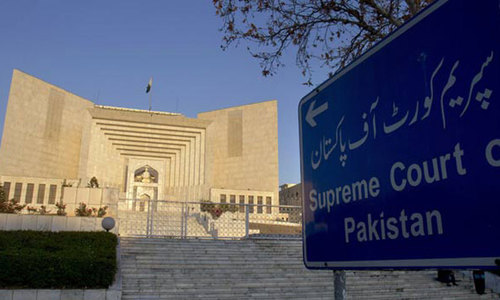
The Supreme Court (SC) ruled on Tuesday that pleas filed by two former army officers against their convictions for plotting to overthrow the government of late prime minister Benazir Bhutto in 1995 were “without merit” and hence, stood dismissed.
The two ex-army officers, Col Mohammad Azad Minhas and Col Inayat Ullah Khan, were arrested on Sept 26, 1995, along with now deceased Maj Gen Zaheerul Islam Abbasi, Brig Mustansir Billa and 38 other military officers on the charge of plotting to storm a corps commanders meeting scheduled to be held on Sept 30 that year at the General Headquarters in Rawalpindi.
The alleged plan included the assassination of then-prime minister Benazir and army chief Gen Waheed Kakar, senior cabinet ministers and military chiefs, to be followed by the proclamation of the Islamic system of Khilafat with Maj Gen Abbasi as Ameerul Momineen.
The details of the conspiracy were revealed after Qari Saifullah Akhtar, one of the conspirators and chief of his breakaway faction called Harkat-ul-Jihad al Islami, turned an approver.
On his witness, the Field General Court Martial (FGCM) awarded seven years of imprisonment to retired Maj Gen Abbasi, when a large cache of arms and military uniforms were confiscated. The FGCM also awarded a 14-year jail term to Brig Mustansir Billa for his alleged involvement in the attempted coup.
Col Minhas and Col Khan were court-martialled in Sept 1996 for their alleged role in the conspiracy by the FGCM and sentenced to four years each in prison by a military court.
Col Khan had challenged the sentence in the Supreme Court in 2000 and Col Minhas in the Lahore High Court which dismissed his appeal in May last year.
In their appeal before the SC, they contended that the sentence was without jurisdiction and with mala fide intention as a consequence of which they had been removed from the military service and their properties and other privileges confiscated.
The apex court had reserved its verdict on their pleas in February last year.
The judgement, a copy of which is available with Dawn.com, said during the course of arguments, the two former officers contended it was mandatory for the prosecution to prove the main offence of “conspiring to wage a war against Pakistan” before starting trial against them on another charge.
They further argued that the principal charge framed under the Pakistan Army Act, 1952 lacked “jurisdiction” and was “illegal” as it “exclusively relates to misconduct or omission committed on the basis of assigned military duty”.
According to the petitioners, their court-martial was based on “mala fide” as the FGCM lacked the jurisdiction to issue the order and hence, it was “not sustainable in the eyes of law”.
In response, the Additional Attorney General for Pakistan contested these claims.
After hearing arguments from both sides, the court observed that the two former officers were rightly dealt with under the Army Act on that matter and as such, their argument that action taken against them under the law be declared based on mala fide had “no legal justification”.
Moreover, their argument that their trial before the FGCM was an “abuse of process has no sanctity” and was “vehemently discarded”, the court order said.
The court observed that if the petitioners’ argument that the concept of duty/ obligation assigned to a military officer necessarily related to a duty/responsibility assigned for a particular task was accepted, “it would amount to a narrow interpretation regarding responsibilities of members of a disciplined force”.
“A military officer of either of the rank is under a bounden duty to execute momentary obligations assigned or not, in order to uphold the dignity, reputation, discipline and above all maintain order of the institution in letter and spirit.
“Any act of omission, which hampers integrity/discipline of the institution would definitely be accountable considering it an act triable under the Army Act,” it said.
The court also termed the pleas filed by the two former army officers in the SC and high court “not maintainable”.
It further observed that petitioners’ had moved the court against their convictions after considerable and “could not give sufficient reason as to why they remained silent for years and did not invoke the constitutional jurisdiction well in time, therefore, on this score alone, their constitutional petitions are liable to be dismissed”.
On the petitioners’ contention against them being deprived of privileges and amenities meant for army personnel, including membership in the housing scheme and allotment of plots, the court noted it was settled that “dismissal from service squarely takes away all the perks, privileges and amenity services from an army personnel conferred in lieu of his induction into the Pakistan Army”.
“There is no second cavil to this proposition that after dismissal from service, the appellant/petitioner cannot claim any benefit because of the reason that their termination was in pursuance of the defiance of the discipline and order of the institution discreetly,” the court order read.
The petitioners’ contention that taking away these privileges and amenities from them made them a “victim of double jeopardy” — a defence that prevents a person from being tried twice for the same crime based on the same conduct — lacked any “legal foundation” and consequently, was “immensely rebutted”.
On the basis of afore-mentioned grounds, their pleas were “dismissed, being without merit”, the court ruled.