0
0

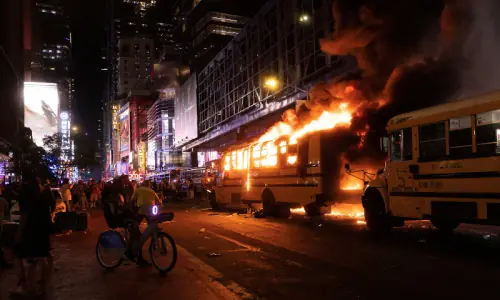
IN the last week of July 1973, trouble erupted in Liaquatabad after clashes took place between workers of the Pakistan Peoples Party (PPP) and the Tehrik-i-Istiqlal (TI) as a result of which 50 persons received injuries. The police resorted to laathi charge and tear-gas shelling in a bid to control the conflict and arrested nearly six dozen people. The tension in the area started when on July 29 rival groups assembled on either side of the main road in Liaquatabad near the PPP offi ce. After an exchange of slogans, they started throwing stones at each other. Later, a notorious character from the neighbourhood rushed to the other side from where he was standing, stabbed four men and returned to where he was. It fuelled fi re to the whole scenario.
On July 31, the ugly situation was condemned by various political groups demanding an impartial inquiry into the incident, exemplary punishment to those responsible for creating the situation, and compensation to the injured as well as to those whose property was damaged.
On Aug 1, the Karachi Bar Association urged President of Pakistan Z A Bhutto to set up a high-powered judicial tribunal for fi xing the responsibility in persons belonging to the law enforcing agencies in connection with the disturbances in Liaquatabad. The association, at an emergency meeting, adopted a resolution expressing grave concerns at the indiscriminate arrests of innocent citizens of Karachi demanding their immediate and unconditional release.
Interestingly, on Aug 2, Provincial Minister for Law and Parliamentary Affairs Syed Qaim Ali Shah, speaking at the launch of a book titled Politics of the People at a local hotel called upon the countrymen to strengthen the hands of the government to enable it to properly execute its schemes aimed at the welfare of the common man. He, paying tribute to the president, claimed that from the very beginning Mr Z A Bhutto had fought for democracy as is evident from his articles and speeches contained in the book. He added Mr Bhutto fought against dictatorship to usher in an era of democracy. He criticised leaders of the opposition parties for inciting people to overthrow a democratically elected government by unconstitutional means.
In contrast, on Aug 4, 114 practising advocates and members of the Karachi Bar urged the government to take steps for establishing a metropolitan government for the ‘Greater Karachi’ area. At a meeting held at the residence of Mirza Javed Beg, convener of the Tehreek-i-Shehri Hakoomat, the participants said in a signed statement that such an arrangement would be in line with similar steps taken by certain other countries for ‘unusually’ big cities. They were of the view that a major cause of deterioration in civic patterns in Karachi was the non-participation of citizens in managing city affairs.
Another indication of the large scale of problems faced by the metropolis was noticed on Aug 5 when it was announced that plots and quarters allotted or sold by the Karachi Development Authority (KDA) to East Pakistanis (now Bangladeshis) could neither be sold nor transferred. The decision was taken after receiving complaints that East Pakistanis were selling/ transferring such pieces of land in anticipation of their repatriation to Bangladesh
Published in Dawn, July 31st, 2023