KARACHI: The impact of rising energy prices on households was examined by experts during a webinar on Wednesday.
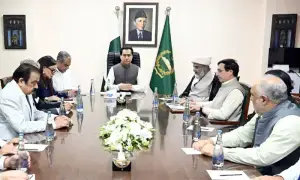
The event, ‘Energy Affordability amid the Economic Crisis,” was organised by The Knowledge Forum (TKF) in collaboration with the Renewable Energy Coalition.
Prof Dr Qais Aslam of the University of Central Punjab (UCP) Business School, Lahore, said energy is now the difference between the developed and underdeveloped economies.
“The energy in Pakistan is neither clean nor cheap, pushing up the environmental costs, the cost of doing business, and the consumption costs,” he pointed out.
He also said that Pakistan has an untapped potential for electricity generation in the form of 100,000 megawatt (MW) from Thar coal, 56,000MW of hydro energy, 150,000MW of wind energy and 50,000MW of solar energy.
“There is hydel, solar, wind, waves, geezers, biogases, biomaterials, nuclear, coal, and gas here, but the country relies upon foreign oil to produce 60 per cent of its electricity. Therefore, it spends much-needed foreign exchange,” he said.
Another problem, as pointed out by the expert, is line losses as well as electricity theft by the government, big businesses, and even the poor.
“It is creating a vicious circle of losses and inefficiency that further makes electricity usage more expensive while increasing the cost of investment and living in Pakistan,” he said. “Successive governments in Pakistan have also imported liquefied natural gas (LNG) at very expensive rates, thus increasing the cost of gas and electricity here.”
As a solution, he suggested Punjab should look into installing more solar panels, and there should be windmills installed all along the Makran Coast.
Dr Sofia Anwar, dean of the Faculty of Economics and Management at Government College University, Faisalabad, spoke about how households navigate through the energy crisis. “There is an increased pressure for food, earning, and transportation as there is an increase in population and an increase in urbanisation,” she said.
“People prefer to iron their clothes and refrigerate their food, so more and more energy is needed. The pace of development over the years requires energy,” she pointed out. “And an increase in the price of energy makes the budget constraint steeper,” she stated.
Dr Khalid Waleed, the research lead for the Sustainable Development Policy Institute (SPDI), said that people are moving towards primitive fuels such as firewood, dunk cakes, etc, at an alarming rate as households go into energy poverty. “The use of such fuels is the cause of indoor pollution that can lead to respiratory illnesses,” he said.
TKF director Zeenia Shaukat said energy is a fundamental necessity of life. It navigates and advances lives.
“But energy comes with a price. There are two aspects to energy, availability and affordability. Now affordability is taking a lead between the two,” she said. “When we speak about energy, we also need to move away from fossil fuels while moving towards renewable energy.”
Sana Muhammed of the Renewable Energy Coalition also spoke at the event.
Published in Dawn, June 8th, 2023