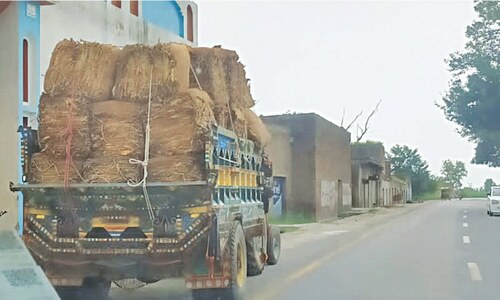
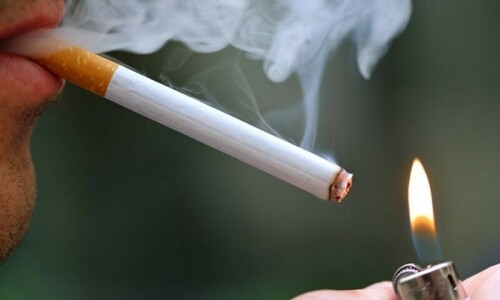
ISLAMABAD: As World No Tobacco Day is being observed across the country on Wednesday, the World Health Organisation (WHO) has urged governments to stop subsidising life-threatening tobacco farming and support more sustainable crops that could feed millions.
On the other hand, stakeholders have demanded enhancement of graphic health warning (GHW) which is stagnant at 60pc since 2019.
“Tobacco is responsible for eight million deaths a year, yet governments across the world spend millions supporting tobacco farms,” said WHO Director General Dr Tedros Adhanom Ghebreyesus.
“By choosing to grow food instead of tobacco, we prioritise health, preserve ecosystems, and strengthen food security for all,” he said.
National Tobacco Control Strategy 2022-2030 launched
A new WHO report titled ‘Grow Food, Not Tobacco’ highlights that more than 300 million people globally were faced with acute food insecurity.
Furthermore, the Ministry of National Health Services Additional Secretary Health Dr Kamran Rehman Khan said that it was a comprehensive and evidence-based roadmap that will serve as a guide in the government’s efforts to reduce tobacco use and protect the population of Pakistan from its detrimental effects.
WHO representative in Pakistan Dr Palitha Mahipala expressed unwavering support for the government in their tobacco control agenda.
Parliamentary Secretary Dr Shazia Sobia Aslam Soomro said that 61 million young people were an asset for Pakistan but addictive and dangerous tobacco products were a threat for their present and future.
Member of National Assembly (MNA) Dr Nisar Ahmed Cheema said that due to inflation, children and youth of Pakistan were facing severe issues in meeting their educational, nutritional, and recreational requirements. Hence, the government’s decision to increase tobacco prices should be welcomed and supported by all.
Former technical head, Tobacco Control Cell of the health ministry Dr Ziauddin Islam said that the tobacco industry claims to be a provider but in reality it was causing damage to the economy.
Track and trace system
Society for Protection of the Rights of the Child (Sparc) Programme Manager Khalil Ahmed Dogar said the track and trace system implemented by Federal Board of Revenue (FBR) in Pakistan was a great way to ensure that the tobacco industry cannot cause any further damage to the economy.
Additionally, more than 100 representative organisations, in collaboration with the Coalition for Tobacco Control, also organised a seminar aimed to raise awareness among the public about adverse health effects of tobacco, the burden on public health budgets, and the spread of tobacco-related diseases.
Meanwhile, another organisation called Chromatic launched the third season of its postcard competition aimed to highlight the positive impacts of increased tobacco prices. Youngsters from all across Pakistan participated by submitting their artistic designs.
During the event, Chromatic’s Chief Executive Officer (CEO) Shariq Khan called for urgent government intervention to protect the younger generation from detrimental effects associated with tobacco products.
Project director of Alternative Research Initiative Arshad Ali Syed in a statement said that the government needed to take along all stakeholders in planning for and achieving a smoking-free Pakistan.
“Today, Pakistan has more than 29 million adults (15 years and above) who are tobacco users. On average, a smoker consumes 13 cigarettes a day. Worryingly, the implementation of laws and regulations regarding tobacco control remains weak. At least 30pc of smokers have reported buying loose cigarettes. The sale of loose cigarettes is prohibited,” he said.
Cigarettes cheaper in Pakistan
A representative of Capital Calling, a network of academic researchers and professionals, Dr Hassan Shehzad said compared to Sri Lanka, India, Bangladesh, China and other regional countries, cigarettes were cheaper in Pakistan.
He said recently, the world’s leading cigarette maker was caught doing illicit trade with North Korea in violation of sanctions. The brand had to pay 635 million dollars and interest to the United States authorities for what its head dubbed “misconduct”.
The government jacked up federal excise duty (FED) on cigarettes in February to discourage the sale of cigarettes and boost its revenue which anti-tobacco activists and the civil society appreciated, urging the government to further increase it, Capital Calling, a network of academic researchers and professionals, said.
More than 1,200 children start smoking in Pakistan every day and there are at least 20 million under-age or minor smokers in the country, where the legal age of smoking is 18 years, it said, adding that smoking exposes people to numerous health risks, including lung cancer, cardiovascular diseases, chronic obstructive pulmonary disease (COPD), and respiratory infections.
According to the network, a recent study highlighted that the government was expecting to collect around Rs200 billion in taxes from the tobacco industry this year after the tax hike. In the last fiscal year, tax collection from the tobacco industry was recorded at Rs148 billion, it added.
Meanwhile, multinational tobacco companies in Pakistan are trying to mislead the government by stating that there is a causal relationship between the rise in taxes and illicit trade of cigarettes. Numerous research studies have proven that share of illicit cigarettes was not more than 18 per cent and that too included smuggling from Afghanistan and Iran.
Published in Dawn, June 1st, 2023