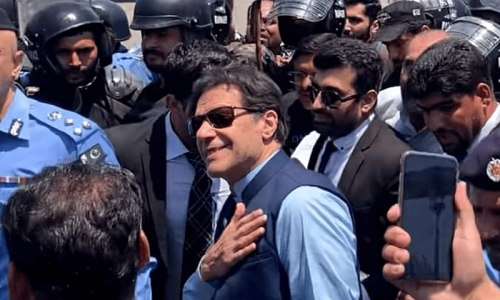
The Islamabad High Court (IHC) has extended its order to prevent the arrest of PTI Chairman Imran Khan in cases filed against him after May 9. The extension is effective until May 31.
Last week, an IHC bench accepted Imran’s bail petition in the Al-Qadir Trust case for two weeks, a day after the Supreme Court termed his arrest in the case “invalid and unlawful”.
It had also stopped authorities from arresting the PTI chief until May 17 in any case registered in Islamabad after May 9 — the day of his arrest.
Today, Imran’s lawyer, Barrister Gohar, represented him in court today. Additional Attorney General Munawar Dugal, Advocate General Islamabad Jahangir Jadoon and state counsel were also present.
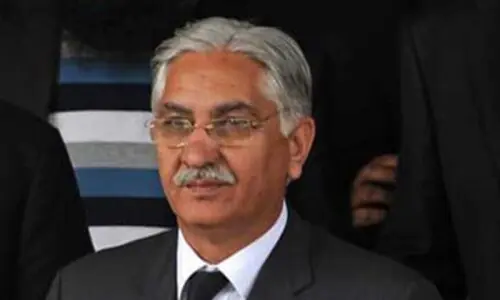
The case was heard by Justice Miangul Hassan Aurangzeb.
The government’s counsel requested more time to provide information about the cases filed against the PTI chief.
The court granted the request and adjourned the hearing until May 31.
Journalists’ boycott
Earlier today, several reporters chose to boycott the hearings conducted by Justice Aurangzeb. This decision came in response to his alleged directive limiting the journalists in his court to five.
Dawn.com’s reporter, along with several others, was denied access to the case hearing related to the ex-PM’s bail today. Upon inquiry, the court’s deputy registrar revealed that the judge had issued an order allowing only a maximum of five journalists to be present in the courtroom. As a result, the journalists boycotted the hearings conducted by Justice Aurangzeb.
Typically, the IHC permits around 30 journalists to attend proceedings related to the cases of the PTI chief, whereas in other cases, there is no specified limit on the number of attendees.

Imran’s arrest
Imran was whisked away from the IHC premises by paramilitary forces on May 9, leading to violent protests across the country. The PTI chief had immediately approached the high court for release but it had declared his arrest legal.
The former premier’s lawyer, Barrister Ali Zafar, then petitioned the SC on his behalf for Imran’s release.
Subsequently, the Supreme Court on Thursday termed Imran’s arrest in the Al-Qadir Trust case “unlawful” and directed him to appear before the Islamabad High Court (IHC) a day later.
“The manner of execution of the arrest warrant issued by the Chairman, National Accountability Bureau (NAB) dated 01.05.2023 in the Al-Qadir Trust case within the premises of the Islamabad High Court against the petitioner is invalid and unlawful,” the ruling had said.
The top court had also highlighted that the fundamental rights of the petitioner under Articles 4, 9, 10-A and 14 of the Constitution had been infringed.
Later on Friday, the PTI chairman was granted a blanket relief from different benches of the IHC that not only barred the authorities from arresting him but also stayed his trial in the Toshakhana case until the second week of June.