SC links affidavit attestation with personal appearance



ISLAMABAD: The Supreme Court on Monday held that the court magistrate or oath commissioner attesting any affidavit should be known to an applicant, who is filing a plea to challenge the candidature of an aspirant for elections.
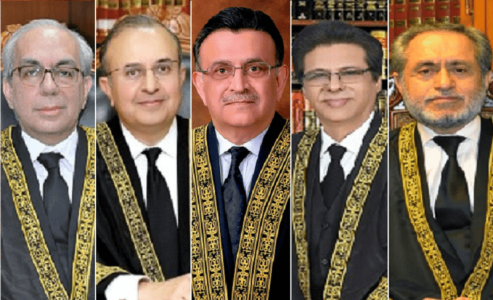
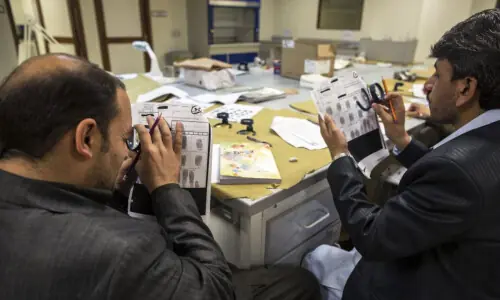
Headed by Chief Justice of Pakistan (CJP) Umar Ata Bandial, a three-judge SC bench while hearing a set of 69 appeals observed that the oath commissioner would attest or verify the legal instrument or affidavit of an applicant on the condition that either he is personally known to the deponent or the oath commissioner is familiar with a third person who identifies the applicant.
However, the court in order to clarify further the competency of election disputes and the meaning of the verification process asked the petitioners’ counsel to come prepared when the case will be taken up again next week.
The CJP observed that the court would elucidate in clear terms the meaning of laws regarding verification of the applicant while deciding appeals concerning a number of National Assembly seats.
The court issued the directions while hearing appeals concerning election disputes of different constituencies of national as provincial assemblies from 2018 to 2022. The court, however, rejected 11 appeals as they had become infructuous after the dissolution of Punjab and Khyber Pakhtunkhwa assemblies earlier this year.
In one of the cases, namely Waqas Akram versus Ghulam Bibi Bharwana, the petitioner had challenged the Oct 9, 2020 rejection of his plea by the election tribunal on the grounds that the petition did not carry the verification of the petitioner as defined under Section 144(4) of the Elections Act 2017.
Umer Riaz, representing Mr Akram, argued that presentation of the CNIC was enough at the time of attestation instead of appearing in person before the oath commissioner. But the election tribunal rejected the plea on technical grounds instead of hearing the matter on merit, the counsel argued from the Lahore Registry of the Supreme Court via web-link.
Justice Ijaz-ul-Ahsan, a member of the bench, observed that law was clear that when the magistrate was personally known to the applicant then the presentation of CNIC at the time of attestation of the affidavit for the election petition would suffice, but the matter needed to be explained if the applicant was not known to the oath commissioner.
In the end, the court rejected Mr Akram’s case on the grounds that the deponent was not known to the oath commissioner and the applicant was identified on the presentation of his CNIC.
Published in Dawn, March 14th, 2023