Constable Ahmed Khan’s colleague had been planning for months to start building a house for his family. He had finally borrowed Rs1.5 million on the morning of Jan 30, 2023. “He had told me he would repay the debt after his retirement. We had then gone to the mosque together for Friday prayers,” Constable Khan recently recalled during a conversation with Dawn.
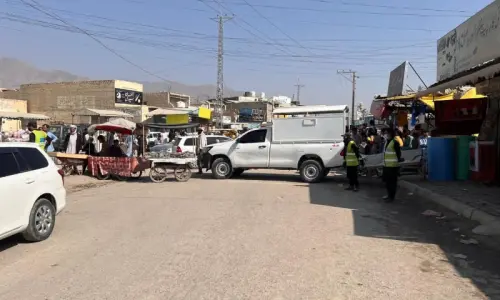
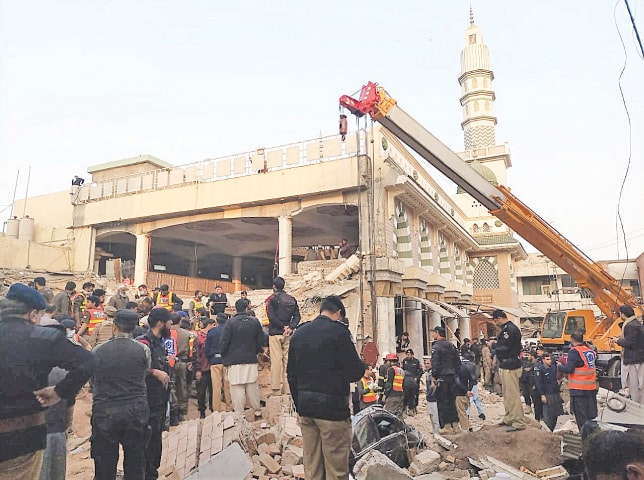
The colleague perished that day in a devastating terrorist attack on the mosque, located in Peshawar’s Malik Saad Shaheed Police Lines. A suicide bomber, disguised in police uniform, had slipped inside with the faithful. He detonated his deadly payload as the congregation prayed. Khan was lucky to survive with the injuries to his head, feet and arms.
He was in the hospital for four days. He recalled that there had been so many injured at the hospital he was taken that it soon ran out of space to accommodate them.
“My head still feels heavy,” he remarked during the conversation. “I think I’ll go to the hospital again on Monday for another check-up.”
Khan said his colleagues had been calling to ask when he would be resuming duty. It was still too soon for him. He said he felt too overwhelmed whenever his mind turns to his fallen comrades.
“There were so many; so full of life and dreams for their future,” he recalled with sadness. “Their lives were wiped out in the blink of an eye.”
Nowsherwan, another of Khan’s colleagues, had 10 children. Eight of them are too young. “How will they make it without their father,” Khan wondered.
The suicide attack, which left 84 dead and over 200 others injured, has once again stirred a debate around Pakistan’s counterterrorism policies and its capacity to deal with militancy.
On February 3, the Apex Committee had met in Peshawar with Prime Minister Shehbaz Sharif in the chair and Army Chief Gen Asim Munir in attendance.
“The civil and military leadership expressed unflinching resolve to protect the people of Pakistan at any cost,” the premier was quoted as saying after the meeting. “Those who attacked innocent citizens will be brought to justice. We will not allow anti-terror gains to be reversed.”
Those who have paid for the state’s failures in blood took the statement with a heavy pinch of salt.
Advocate Ajun Khan, a Peshawar High Court lawyer who lost his firstborn son, Asfand Khan, in the 2014 Army Public School massacre, said he was sceptical of promises to eliminate terrorism and militancy through military operations and crackdowns.
“There have been countless military operations and nothing came out of them.” Ajun said. “These operations are just meant to mint money.”
He said all Pakistan needs to do is put its house in order and implement the National Action Plan, which the country’s political and military leadership had agreed upon following the APS massacre, with honesty. “The indiscriminate implementation of NAP is the only solution to the militancy problem,” he said. All the talk of crackdowns and stern actions is just talk, he added.
He noted that public patience for terrorism was wearing thin. The people of Swat, Bajaur, Malakand and Peshawar have recently taken to the streets to raise their voice against the resurgence of militancy. “This should be a wake-up call for our policymakers,” he said.
Khalil Jan, a resident of Mingora, urged decisive action against terrorism. “We can talk in other situations, but terrorism requires strict action and should be eliminated,” he said.
Jan lost his brother on February 29, 2008, in a suicide attack on the funeral of a police officer. The martyred police officer had been Jan’s neighbour and he, along with his brother and father, had gone to attend the funeral.
The brother, Faizullah Khan, had been the elder sibling. He ran a promising business in Mingora, which he had set up after completing a master’s degree. “His death dealt a crushing blow to our family. Our business gradually declined until it closed down,” Jan said.
Israr Khan, another cop who was injured in the Peshawar police lines mosque attack, told Dawn that he has no recollection of how he was injured in the blast. “I opened my eyes in hospital, surrounded by relatives,” he said.
He regretted that Pakistan was currently not on the right track, and that it needed to correct course for the sake of its citizens.
“The police have offered heavy sacrifices to maintain law and order and will continue to do so; however, the government needs to take proper steps to address this issue,” he added.
Published in Dawn, February 18th, 2023