0
0

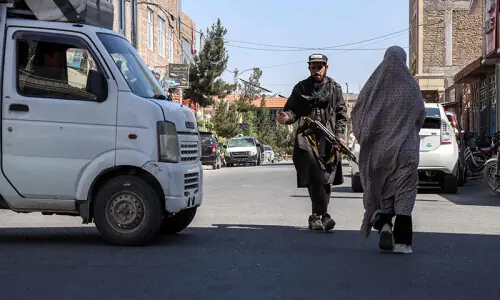
MONS (Belgium), Jan 6: Nato’s military chief said on Friday that the Taliban and Al-Qaeda were not regrouping in Afghanistan despite more than a dozen suicide attacks there in the last three months.
“There’s a knee-jerk reaction that wants to say: ‘Oh, the Taliban is coming back’ or ‘Al-Qaeda’s coming back’. I don’t know of any commander or any estimate that can say that with certainty,” US General James Jones said.
Jones acknowledged that some members of the former Taliban regime, which was ousted by a US-led coalition in 2001, and Al-Qaeda were operating in Afghanistan but that there was also plenty of criminal activity.
“The violence that we’re seeing is disparate and I don’t think it is focused. In other words, I don’t see an allegiance between, say, criminal gangs and the Taliban, or narco-traffickers and Al-Qaeda,” he said.
“These are different groups that have their own agenda,” he told reporters at Nato’s military headquarters in Mons, southern Belgium.
Ten people died and 50 were wounded on Thursday in a suicide bomb attack in central Afghanistan during a visit by the US ambassador. The Taliban claimed responsibility.
More than 30 people have been killed in more than a dozen suicide attacks in the last three months. Most bombings have been blamed on remnants of the Taliban, who are thought to be copying the tactics of insurgents in Iraq.
Jones said he had studied data about attacks in Afghanistan since the Nato-led International Security Assistance Force began operating there in late 2001 and that no new spike or trend was evident. “Historically there is no rise, no significant change from one year to the other in terms of incidents,” he said.
But he added that attacks sometimes rose short-term in response to events, like the two new stages of ISAF’s expansion into volatile southern Afghanistan which are due to start in the next six months.
“With Nato coming into stage three and stage four, obviously people are trying to send a message to try to discourage or intimidate,” he said.—Agencies