NEW DELHI: Indian farmers formally ended year-long mass protests on Thursday after Prime Minister Narendra Modi abandoned his push for agricultural reforms, defusing one of the biggest challenges faced by his government.
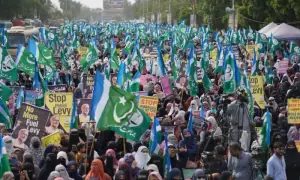
Thousands of people have been camped on the outskirts of the capital New Delhi since last year to campaign against laws they said would have led to a corporate takeover of the sector.
Modi’s administration rushed through a repeal of the laws last month in a rare backdown, and farmer representatives said they agreed to stand down after the government agreed to other demands.
“Farmers’ unity, peace and patience has been the key to the victory and this will not be allowed to erode in any circumstance,” said Samyukta Kisan Morcha, a coalition of farmers’ unions, in a statement.
Protesters began disassembling their makeshift camps on the highways leading into the capital on Thursday.
They plan to wait until after a funeral for India’s defence chief General Bipin Rawat, who died in a helicopter crash on Wednesday, before returning to their homes on the weekend. Protests had carried on in smaller numbers after the repeal of the laws, with farmers seeking additional concessions including compensation for the families of the more than 700 farmers they say died during the protests.
The government agreed to that demand and also pledged not to prosecute those using fire to cheaply clear their fields — a practice that regularly shrouds Delhi in smog each winter.
About two-thirds of India’s 1.3 billion population draw their livelihood from farming and the sector has long been a political minefield.
Thousands of Indian farmers die by suicide every year because of poverty, debt and crops affected by ever more erratic weather patterns caused by climate change.
The three agricultural laws passed in September 2020 aimed to deregulate farm produce markets, where state bodies have for decades set guaranteed minimum prices for crops.
But the reforms became a lightning rod for opposition to Modi’s administration by farmers, who said the changes would have left them at the mercy of big business.
The protest sites on highways leading into Delhi turned into colourful, semi-permanent camps, with volunteers providing food, sanitation and even dentist surgeries and foot massage parlours.
One rally turned violent in January when a tractor convoy transformed into a rampage that embarrassed the government on Indian Republic Day, leaving one farmer dead and hundreds of police injured.
Modi’s reversal came ahead of important elections for his Bharatiya Janata Party (BJP) in Punjab and Uttar Pradesh states, both home to huge numbers of farmers.
Economists however said the decision to repeal the laws doomed any prospect of fixing the agricultural industry’s underlying problems.
“The government will always put political considerations such as state elections over sensible economic policy or environmental considerations,” economist Mihir Swarup Sharma of the Observer Research Foundation think-tank said.
“The failure to impose penalties for stubble burning is a serious setback to attempts to improve North India’s air quality, which is the worst in the world by far.”
Published in Dawn, December 10th, 2021