0
0


ISLAMABAD: The Council of Islamic Ideology (CII) on Thursday gathered various Islamic scholars who gave a ruling (fatwa) that smoking is impermissible, undesirable and unlawful, due to its negative impact on the human health.
They were gathered at a conference organised by the Society for the Protection of the Rights of the Child (Sparc) along with CII.
Participants of the conference were told that the lethal effects of smoking are increasingly noticed by society. Not only are these effects detrimental for smokers but also for those exposed to cigarette smoke, especially the younger generation, which is why scholars feel the need to remind the public of these dangers.
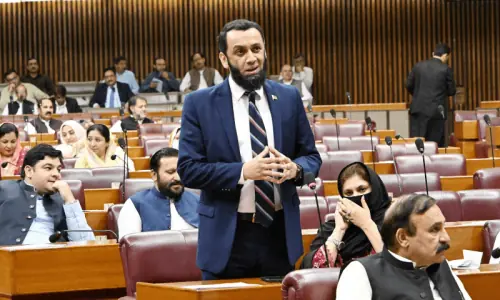
Minister of State for Parliamentary Affairs Ali Mohammad Khan said that in a young country such as Pakistan, an exaggerated impact of smoking will be seen as the population ages and develops myriad health problems associated with tobacco, including chronic lung and heart disease and almost all cancers.
Policies to check tobacco consumption need urgent revision, minister says
In the absence of changes in tobacco taxation for years, policy planning to check tobacco consumption and meet international targets needs urgent revision, he said.
Chairman of CII Qibla Ayaz brought the audience’s attention to a saying of Prophet Muhammad (peace be upon him) and said that smoking is not only a danger to oneself but to others as well, as cigarettes have proved to be a source of several diseases, both for smokers and those exposed to second-hand smoke.
He said that considering harms of cigarettes, the CII and leading Islamic scholars present in the conference are in harmony about the fact that smoking according to Islamic law is in the category of activities that need to be stopped.
During the conference, Malik Imran Ahmed, country head of Campaign for Tobacco-Free Kids Pakistan, while referring to other Islamic countries mentioned that in 2000, grand mufti of Egypt Dr Nasr Farid Wasil ruled that smoking was forbidden in Islam because of its harmful health effects.
“Our country is particularly vulnerable to weak tobacco control implementation as the impact is most sensitively seen in the country’s youth. About 1,200 children in Pakistan between the ages of six to 15 years start smoking every day with 170,000 deaths yearly,” he said, adding the total costs attributable to smoking-related diseases and deaths in Pakistan for 2019 are Rs615.07 billion whereas, the tobacco industry’s total tax contribution (Rs120 billion in 2019) is approximately just 20 percent of the total cost of tobacco consumption.
He requested the government to acknowledge recommendations of the CII and to take measures to eradicate smoking and declare the sale of tobacco products illegal. We appeal proper legislation on tobacco taxation, to limit its consumption.
Meanwhile, general secretary of Pakistan National Heart Association (Panah) Sanaullah Ghuman criticised the government’s action of opposing imposition of health hazard tax on tobacco and sugary drinks.
“Though the health hazard tax was tabled in the Economic Coordination Committee by Special Assistant to Prime Minister on Health Dr Faisal Sultan, it was blocked by the Advisor on Finance and Revenue Shaukat Tarin. Sugary drinks are becoming the reason of diabetes and heart related diseases but unfortunately government did not bother to impose tax.
“Health levy should be imposed so that the revenue of the government would be increased and consumption of sugary diseases would be decreased but the finance minister said that this is not the right time to increase the prices of sweet drinks and tobacco but it is the right time to increase the prices of petrol, electricity and gas for the people suffering from economic crisis,” Mr Ghuman added.
Published in Dawn, November 19th, 2021