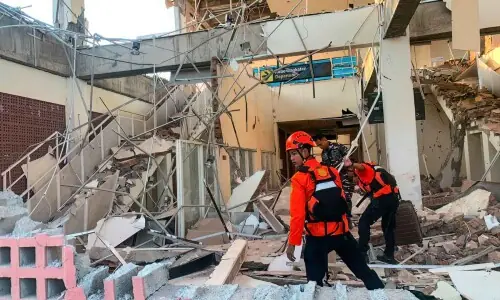
KARACHI, Nov 15: A record number of acts of terrorism have taken place in the so-called “High security zone” of the city ranging from bomb blasts to target killings of foreign nationals retrospectively. The term high security zones was coined by the former police chief of Sindh. Majority of the acts of terrorism occurred in the morning rush hours.
Apart from the Tuesday blast, a blast ripped through the National Bank Branch housed at the corner of the PIDC House in 1996. Several employees and passers-by were wounded in the explosion. The explosive device was placed in a flower pot placed at the steps of the bank.
On Nov 11, 1997, four US nationals and their Pakistani driver was gunned down a few metres away from Tuesday’s site of blast. Four American auditors of Union Texas Petroleum were heading towards the company’s house in Bahria Complex from a five star hotel. They were gunned down by unidentified armed men as their car descended from the Love Lane Bridge. Following the incident, the company evacuated all its 30 personnel from Pakistan. But, later the company relocated its offices in Islamabad.
On May 8, 2002, eleven Frenchmen and five Pakistanis were killed when a car laden with explosive dashed into a bus of Pakistan Navy. The bus was carrying the French technicians to the Karachi Shipyard where they were engaged in the development of Augosta submarine. Work on the submarine project was suspended for the time being, but later resumed.
On June 14, 2002, a bomb blast rocked the US consulate-general killing 12 lives and injuring scores of people. Following the blast, the consulate suspended its operations, but later resumed the routine work in heavily fortified concrete structures, taking over the third lane of Abdullah Haroon Road.
On June 10, 2004, the convoy of Corps Commander Karachi was ambushed in a ‘high security zone’ in the morning some feet away from the Clifton Bridge killing 11 persons, including seven soldiers.
Last year, two blasts of minor intensity occurred across the Chief Minister’s House at a sideline linking Dr Ziauddin Ahmed Road and Beaumont Road in the morning. However, no one was reported hurt in the explosion.
A rocket, aimed at the CID Civil Lines offices, was fired from a playground in Hijrat Colony located beneath the Love Lane Bridge in May 2004. According to police, the rocket missed its target and landed 8kms away at a marriage lawn located at Jehangir Road. Police recently claimed to have nabbed the suspect involved in the rocket firing.
Also in May 2004, two blasts ripped through two cars parked in front of the Pakistan American Cultural Centre located close to the residence of US Consul-General. A policeman died and several persons including policemen, journalists were wounded in the blast.
On June 6, 2004, the Capital City Police Karachi decided to divide the city in different ‘security zones’ under a security plan. Clifton Town and Saddar Town were divided in 12 security zones.
The move was aimed at combating terrorism, safeguarding lives and property of citizens and providing security to important installations.
The created zones were: Corps Headquarters, Rangers Headquarters Jinnah Courts, Governor’s House, naval establishments, Sindh Secretariat, Sindh Assembly building, Sindh High Court, US Consulate-General, Residence of US Consulate-General, British Deputy High Commission, Police Head Office (PPO office) and DIG Operations office.
The former provincial police chief, Syed Kamal Shah, had directed the police department to finalize the arrangements for such security zones in other towns of Karachi without any delay.
Issuing directives to the Town Police Officers, the IGP asked them to deploy necessary force at checking points in the security zones. The check points would be set up at the main roads passing near the security zones with an ASI or head-constable of the police for coordination. The personnel so deployed at the checkpoints would be kept informed of any development and directives.
In case of any car snatching or such other incident, the operations base were suppose to convey the details of vehicles to the checkpoints of all the security zones. Moreover, the details of all the checked vehicles would be kept at Reader Branch of each town.
However, it seems that installation of the so-called security cameras at various sensitive points in the high security zones have failed to deter the terrorists who every now and then take security and intelligence agencies by surprise.