5
5


CAPE CANAVERAL: A billionaire e-commerce executive and three less-wealthy private citizens chosen to join him blasted off from Florida on Wednesday aboard a SpaceX rocket ship and soared into orbit, the first all-civilian crew ever to circle the Earth from space.
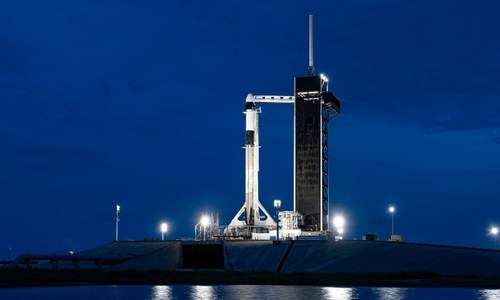
The quartet of amateur astronauts, led by the American founder and chief executive of financial services firm Shift4 Payments Inc, Jared Isaacman, lifted off just before sunset from the Kennedy Space Centre in Cape Canaveral.
A SpaceX webcast of the launch showed Isaacman, 38, and his crewmates — Sian Proctor, 51, Hayley Arceneaux, 29, and Chris Sembroski, 42 — strapped into the pressurised cabin of their gleaming white SpaceX Crew Dragon capsule, dubbed Resilience, wearing their helmeted black-and-white flight suits.
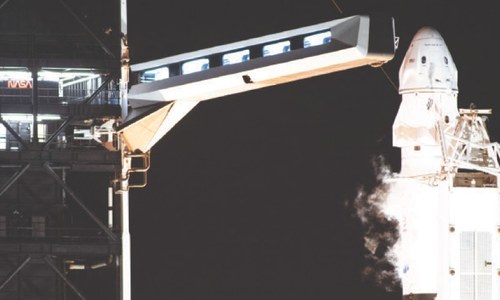
Thumbs-up were on display as the capsule streaked into the dark sky, perched atop one of SpaceX’s reusable two-stage Falcon 9 rockets. The Crew Dragon, fitted with a special observation dome in place of its usual docking hatch, reached orbit almost 10 minutes after the 8:03pm blastoff.
The rocket’s first-stage booster, after separating from the spacecraft’s top half, flew itself back to Earth and touched down safely on a landing platform floating in the Atlantic on a drone ship whimsically named Just Read the Instructions.
Amid cheers heard in SpaceX’s mission-control centre as the spacecraft climbed to nearly 200km above Earth, Isaacman read a statement thanking those who made possible a journey “right to the doorstep of an exciting and unexplored frontier, where few have come before and many are about to follow”.
“The door is open now, and it’s pretty incredible,” he said.
Within three hours the capsule had reached its final cruising orbital altitude of just over 585km — higher than the International Space Station or Hubble Space Telescope, and the furthest any human has flown from Earth since NASA’s Apollo moon programme ended in 1972, according to SpaceX.
At that height the Crew Dragon was circling the globe once every 90 minutes at a speed of some 27,360km per hour, or roughly 22 times the speed of sound.
The flight, representing the first crewed mission to orbit with no professional astronauts, is expected to last about three days from launch to splashdown in the Atlantic, mission officials said.
NASA, which exercised a government-run US monopoly over spaceflight for decades, has embraced the nascent commercialisation of rocket travel.
In a Twitter message posted shortly before Wednesday’s launch, the space agency said: “#Inspiration4 embodies our vision for a future in which private companies can transport cargo and people to low-Earth orbit. More opportunities to fly = more opportunities for science.”
Published in Dawn, September 17th, 2021