THE inauguration of the Biden administration has predictably generated a heated debate on America’s likely policy concerning Pakistan. Any analysis of the emerging scenario must be firmly grounded in strategic realities rather than in wishful thinking.
The end of the Cold War had already reduced Pakistan’s importance in America’s strategic calculations. On top of that, there is now growing strategic divergence between Pakistan and the US because of the development of the Indo-US partnership as an essential element of the US policy of containment of China, on the one hand, and the deepening cooperation between Pakistan and China on the other. CPEC is a prime example of growing Pakistan-China cooperation.
Additional factors which will influence US policy on Pakistan are India’s economic weight with a GDP of $2.6 trillion, its increasing global political influence as evidenced by its current membership of the UN Security Council and G20, and its position as the world’s largest democracy despite the setbacks caused by the rise of Hindutva under Narendra Modi. By way of comparison, Pakistan’s economy is in dire straits with a GDP of only $285 billion, there is political instability and its journey as a functioning democracy has been interrupted several times in the past. Still, as a nuclear power with considerable military strength, Pakistan’s importance in strengthening regional peace and stability cannot be ignored.
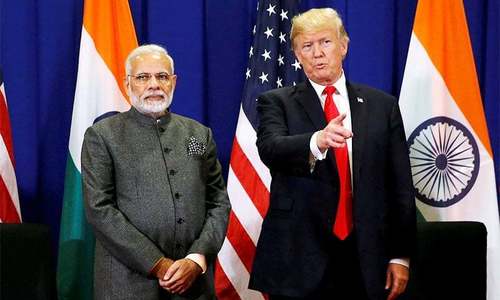
The Biden administration’s initial policy statements clearly show that it is determined to continue the policy of developing a strategic partnership with India in pursuit of the policy of containment of China. It is worth underscoring that the US policy of developing strategic cooperation with India had been supported by the Clinton, Bush, Obama and Trump administrations. Unsurprisingly, US Secretary of State Antony Blinken at his confirmation hearing stated that America’s relations with India were “a bipartisan success story”. Defence Secretary Lloyd Austin at his confirmation hearing assured Congress that the Biden administration would “operationalise India’s Major Defence Partner status”.
How will US-India ties impact Pakistan?
The increased presence of Americans of Indian origin in powerful positions in the Biden administration may reinforce the trend of deepening cooperation between the two countries, especially in military, nuclear and high-tech areas thereby upsetting further the strategic balance in South Asia to Pakistan’s disadvantage. In short, India is likely to be given the central role in the US Indo-Pacific strategy which will also involve the strengthening of the Quadrilateral Security Dialogue or Quad involving India, Japan, US and Australia as affirmed by President Joe Biden in his recent telephone conversation with Prime Minister Modi.
Consequently, it would be unrealistic to expect that under Biden, the US would resume large-scale economic and military assistance to Pakistan or would be helpful in the search for a just settlement of the Kashmir dispute in accordance with the UN Security Council resolutions and the aspirations of the Kashmiri people. The harsh reality is that America lacks both the will and the capacity to influence India’s position on the Kashmir dispute. It will, therefore, continue paying lip service to the need for a peaceful settlement of the Kashmir dispute while being supportive of Indian hegemonic designs in South Asia.
However, there are several areas in which the two countries can engage in mutually beneficial cooperation. Currently, the Biden administration is reviewing the deal signed by the US and the Afghan Taliban in February last year aimed at American military withdrawal from Afghanistan, an end to terrorism originating from Afghanistan, and a peace settlement between the Taliban and the Kabul regime. It is in the mutual interest of Pakistan and the US to promote the ongoing intra-Afghan dialogue for achieving these goals. The same can be said about Pakistan-US cooperation for combating terrorism from which both countries have suffered grievously. Pakistan would be well advised to remove ambiguities in its policies concerning this issue.
Other areas in which Pakistan and the US can engage in mutually beneficial cooperation are the prevention of nuclear proliferation, promotion of peace and stability in South Asia, the Persian Gulf and Indian Ocean regions, climate change, promotion of human rights and strengthening of bilateral cooperation in economic, commercial, technical and cultural fields. The test of Pakistan’s diplomacy would lie in its ability to reconcile the elements of divergence and cooperation into a coherent whole mindful of both the potential and limitations of the Pakistan-US relationship.
The writer is a retired ambassador and author. He is president of the Lahore Council for World Affairs.
Published in Dawn, March 2nd, 2021