SC again censures NAB, says its officers are not competent


ISLAMABAD: The Supreme Court censured the National Accountability Bureau (NAB) once again on Tuesday when it held that the NAB office itself was responsible for delay in deciding corruption references since its officials were not competent.
The NAB officers do not possess enough expertise to conduct proper inquiries/investigations and it seems that no measure was in place on the basis of which such inquiries/investigations were examined, Chief Justice of Pakistan Gulzar Ahmed said.
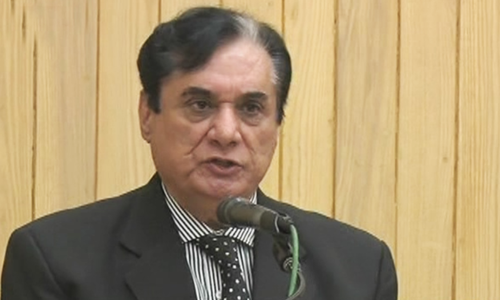
The observations came despite the justification provided by NAB chairman retired Justice Javed Iqbal before the Supreme Court by enlisting a number of reasons that caused a delay in deciding corruption references in the accountability courts.
In its order, the bench regrets that NAB officers conduct faulty inquiries or investigations
In a report submitted to the Supreme Court, the NAB chairman had conceded that it was impossible to adjudicate and finalise corruption references within 30 days keeping in view that there were 1,226 pending references, the current strength of the accountability courts as well as the workload.
The report was furnished before the Supreme Court in a suo motu case regarding delay in trials before the accountability courts in the light of Section 16 of the National Accountability Ordinance (NAO) 1999, which asks for deciding corruption matters within 30 days.
The suo motu proceedings were initiated when Justice Mushir Alam had requested the chief justice on Jan 8 to constitute a special bench and initiate suo motu proceedings over the delay in prosecuting the accused before the trial courts.
On July 8, the Supreme Court had ordered Prosecutor General Syed Haider Asghar to furnish a report duly signed by the NAB chairman suggesting ways to clear the backlog.
Now in a three-page order, the Supreme Court bench, consisting of Chief Justice Ahmed, Justice Mazhar Alam Khan Miankhel and Justice Yahya Afridi, regretted that the NAB officers conduct faulty inquiries or investigations. These then turn into a reference — a reference which in turn becomes a non-starter in accountability courts.
The Supreme Court went on to say that delays in deciding cases were caused because NAB did not have proper supporting material before finalising the reference, which was essential to bring the case to a conclusion.
“In our view, the chairman, who has the power to approve the reference, should examine the reference first and give his opinion so that the reference goes before the trial court smoothly and results into conviction,” the chief justice observed.
He further said the NAB law provided that the reference should be decided within 30 days.
“This was mandated by the legislature with a purpose and it was never the wish of the legislature that NAB cases become difficult for an accountability court to try and decide.”
The NAB should ensure that when the reference is filed before an accountability court, it should be decided within a month, as provided by the law, the order said.
It added that the problem thus lies with NAB, its officials and prosecutors, who have the capacity issue and such aspect of the matter, needs to be addressed by the chairman.
If the chairman thinks that his team is not efficient enough, he should take steps to remedy the situation and change his team immediately, the chief justice observed.
He directed the bureau chairman to furnish a reply on the next date of hearing.
During an earlier hearing, a former president of the Supreme Court Bar Association, Amanullah Kanrani, had pointed out that the rules under Section 34 of the National Accountability Ordinance 1999 had still not been framed.
Instead, he added, NAB follows certain SOPs.
“We note that SOPs are no substitute for rules and the rules need to be framed by NAB,” the chief justice observed. The court expected that the rules would be framed by the chairman in terms of Section 34 of NAO at a fast pace and by the next date the same would be submitted to the court, he added.
The case will be taken up after a month.
Referring to the matter of raising the number of accountability courts, the law secretary informed the apex court that the final decision regarding setting up of 120 accountability courts would be taken within one month and after seeking approval from the cabinet, the law ministry would appoint judicial officers in the courts and also for creating infrastructure where the new judges will be in a position to comfortably try the cases.
The chief justice ordered the secretary to submit a report under his own hand.
Published in Dawn, July 29th, 2020