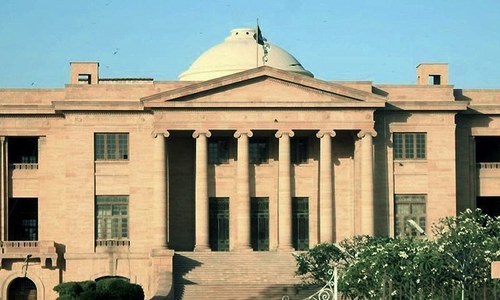
SC sets aside SHC stay order, allows govt to take action against sugar mill owners


The Supreme Court on Tuesday, setting aside a stay order by the Sindh High Court, allowed the government to take action against sugar mill owners in light of recommendations of the sugar inquiry commission.
A three-member bench, comprising Justice Ijazul Ahsan and Justice Mazhar Alam Khan Miankhel and headed by Chief Justice Gulzar Ahmed, heard the case.
In its short order, the top court told federal authorities to "operate in accordance with the law". The court also cautioned the government against taking "unnecessary steps" against sugar mill owners. Additionally, government officials were restrained from commenting on the sugar commission report.
The Supreme Court directed the high courts of Sindh and Islamabad — where cases pertaining to the matter were being heard — to issue a decision within three weeks. The IHC has issued a verbal order in the case but a detailed order is yet to be issued.
During the proceedings, the attorney general argued that SHC's order was "against the law".
He told the apex court that the government was also constituting a commission on the fuel shortage face by the nation recently but wanted the "stay order problem to be resolved first".
A detailed judgement is expected to be released later.
Sugar probe report and action
On Feb 20, the government constituted an inquiry committee to probe into a sudden hike in sugar price and shortage of the commodity across the country. It was asked to ascertain if the production this year was less than past years, if the low produce was the prime reason for price hike and whether the minimum support price was sufficient.
On May 21, the commission delivered its report identifying potential violations of laws by different manufactures of sugar and others acting in collusion or in concert with the manufacturers of sugar thereby being liable to possible legal action(s) or proceedings as warranted under different statutes.
On June 10, the Pakistan Sugar Mills Association (PSMA) moved petitions before the Islamabad High Court against the constitution of the inquiry commission and its report. Later, they approached the SHC.
Last month, the SHC had restrained the federal authorities from taking action against around 20 sugar mills of Sindh on the sugar inquiry commission's report. Its stay order came in a case filed by Mirpurkhas Sugar Mills and around 19 other mills of Sindh against the report of the inquiry commission against cartelisation and price hike of sugar.
The federal government challenged the stay order in the top court, arguing that if the contention of the sugar mills were to be accepted, no authority would ever be able to take any action against any party on the apprehensions that it may adversely affect its name, business and reputation.
The federal authorities further said that the instant matter related to the fundamental rights of the people, in particular the right to life under Article 9 of the Constitution, which includes the right to have access to essential food items to sustain their lives at a reasonable and affordable cost without being charged exorbitant amount for items such as sugar.
Meanwhile, the IHC, in an order last month, had allowed the government agencies to take action against the sugar barons responsible for the shortage of the commodity earlier this year and dismissed a petition requesting the court to stop a crackdown started on the basis of the inquiry report.
While disposing of petitions of the PSMA and sugar mill owners, the IHC declared the constitution of the inquiry commission to probe the cartelisation and price hike of sugar lawful and also validated its proceedings and report.
In its order, the IHC declared: “The constitution of the commission vide notification, dated 16.03.2020, read with notification, dated 25.03.2020 and pursuant thereto its proceedings and report, dated 21.05.2020 have not been found to be ultra vires of the Pakistan Commission of Inquiry Act, 2017 nor in violation of the fundamental rights of the petitioners. The report, dated 21.05.2020 was, therefore, lawfully considered by the federal cabinet in its meeting held on 21.05.2020.”