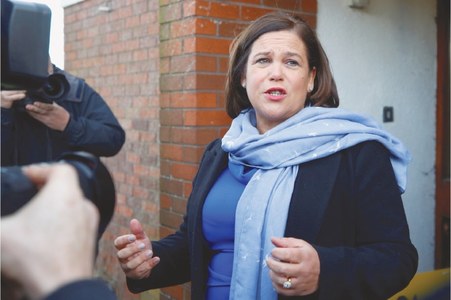
DUBLIN: Sinn Fein’s election success has turned the spotlight on the party’s flagship policy of calling for a referendum on a united Ireland within five years.
Here are some of the key issues at stake:
Why is the island divided?
The island of Ireland joined Britain in 1801 after numerous invasions by Vikings, Normans and then the British Crown.
But many Irish continued to campaign for independence and a Roman Catholic group called the Irish Republican Army (IRA) began a guerrilla war in 1919.
Two years later, the under-pressure government in London split the island into a Catholic-majority Irish Free State in the south and a Protestant-majority Northern Ireland.
The issue of control continued to dominate, however, and from the 1970s Northern Ireland was plagued by sectarian violence between advocates and opponents of British rule that left 3,500 people dead.
In the 1998 Good Friday peace accords, both London and Dublin revoked their constitutional claim to sole sovereignty in the north, saying the people of the island should decide.
What does the peace deal say?
The Good Friday Agreement recognised “the legitimacy of whatever choice is freely exercised by a majority of the people of Northern Ireland”, whether to stay part of the UK or join with Ireland.
It acknowledged that a majority favoured British rule at that time but said that if a referendum found this to have changed, London would agree to legislate to allow reunification.
Britain must order a referendum if it appears likely that a majority of those voting would prefer to join with Ireland.
Where do the Irish parties stand?
Sinn Fein leader Mary Lou McDonald says the government in Dublin should start preparing for a border poll within five years.
Prime Minister Leo Varadkar’s Fine Gael is in favour of a united Ireland but in its election manifesto warned that calls for a poll now would only create division.
Likewise, its centre-right rival Fianna Fail, which had propped up Varadkar’s government, backs unity but warned in its manifesto that it must not be done in an “aggressive, partisan manner”.
Is there public support?
Polling by British Conservative Michael Ashcroft, published in Sept 2019, found Northern Ireland split down the middle over unification.
Some 45 percent said they would vote to stay in the United Kingdom (UK), and 46 percent would vote to join the Republic of Ireland. The rest did not know.
In May 2018, a study led by Queen’s University Belfast found just 21 percent backed a united Ireland, while 50 percent said they would vote to stay part of the UK.
But the authors noted this could be affected by the terms of Britain’s relationship with the European Union — including Ireland — after Brexit.
An EU deal addressing the immediate issues raised by Britain’s exit last month included arrangements to keep open the border between Northern Ireland and Ireland, but overall United Kingdom-European Union trade ties have yet to be agreed. In the Republic, there is support for Irish unity.
A Panelbase poll for The Times earlier this month suggested four in five Irish want to see a united Ireland at some point — and 40 percent within a decade.
What does London say?
Prime Minister Boris Johnson is fighting off demands from Scotland’s nationalist government for a new independence referendum and has expressed strong support for Northern Ireland’s place in the UK.
Asked about the possibility of unification in the wake of the Irish election, his spokesman said: “The Belfast Good Friday Agreement is very clear on what the conditions are for a border poll.”
Published in Dawn, February 12th, 2020