Police to install 10,000 surveillance cameras in Karachi


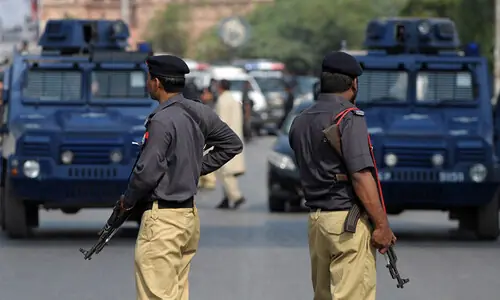
KARACHI: While police are planning to install thousands of closed-circuit television cameras (CCTVs) in the metropolis to detect crimes and bring culprits to justice, Karachi police chief Ghulam Nabi Memon on Friday encouraged the people as well as businesses to install surveillance cameras on their own to fight crime.
Talking to Dawn, Mr Memon observed that in the absence of the Karachi Safe City project, “we will apply the Sindh Security of Vulnerable Establishments Act 2015 and coordinate with all the stakeholders to install CCTV cameras at important places of the city”.
“We are targeting about 10,000 cameras to be installed in next six months,” he added.
He said that it was a badly needed move, which would “help us in detecting crimes”.
A recent analysis by the police about installation of CCTV cameras in some localities with the help of the Citizens-Police Liaison Committee (CPLC) revealed that such an initiative helped in controlling crime, particularly muggings.
IOs being trained to make ‘foolproof’ cases
The city police chief disclosed that the department had analysed about 1,000 cases in which the accused arrested by the police were acquitted by the courts.
“We have compiled frequent reasons [for] such acquittals,” he said, adding: “The IOs [investigation officers] are being given necessary training to not repeat such mistakes in order to prepare foolproof cases.”
The police chief believed that it would help in improving the conviction rate.
“We are mapping crime data of repeat criminals,” Mr Memon said, adding that the police were also devising a strategy to launch dedicated teams to counter such criminals.
30 crime scene units by next year
The police chief said that six state-of-the-art crime scene investigation units had been established in Karachi with the help of the office of the inspector general of police. “The [six] units are helping investigators to collect evidence from crime scene.”
He said that 30 more such units would be established in the next year.
Regarding drug dens in the city and involvement of addicts in street crimes, he said that the Karachi police were making efforts to convince the government to establish rehabilitation centres for drug addicts.
The police suggested that narcotics were a contributory factor behind unabated street crimes.
“Narcotics addicts are heavily involved in criminal activities,” he said.
He hoped that their rehabilitation would help reduced street crimes.
He pointed out that a “successful” drive against gutka, mawa and mainpuri was carried out in the city in which over 114 factories were seized and 4,520 suspects were arrested.
“We are now carrying out a drive against narcotics paddlers and addicts,” he said. “Only in last two months, we have arrested 2,898 addicts, who were either sent to jails or rehabilitation centres.”
About the financial aspect of the police’s future strategy, the city police chief said the government would be asked to provide budget to all police stations. “We have so far got sanctioned budget for three model police stations.”
He opined that the budget at the level of a police station would also help in improving the thana culture.
Security & emergency response division
About other initiatives, Mr Memon said that they had diverted some human and transport resources to Madadghar-15 in order to improve police emergency response.
“The average response time is now 12.5 minutes, which used to be over 20 minutes a few months ago,” he said.
He pointed out that the IGP Sindh had created the Security and Emergency Response Division in the Karachi police and it was helping the force in “improving police response” to any eventuality.
“We have done away with the ‘discretion’ in transfer and posting of Station House Officers (SHOs) and Sub-division Police Officers (SDPOs),” he claimed. “The policy of ‘one man’s decision’ is now being changed with the ‘collective decision’ of a board comprising seven senior police officers.”
Because of this policy, “we are able to post better police officers at police station and sub-division levels resulting in marked reduction of high-handedness and corruption at police stations level,” he added.
Published in Dawn, January 25th, 2020