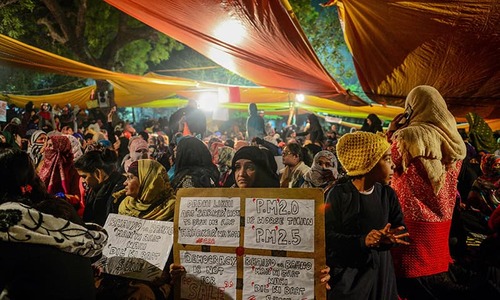
NEW DELHI: Defiant women who have been blocking a New Delhi highway for more than four weeks in protest against a bitterly disputed citizenship law have inspired thousands across India to copy their challenge to the Hindu nationalist government.
Supported by volunteers who bring biryani, tea and blankets, groups have started similar protests in about 20 cities across the country of 1.3 billion people to demand the repeal of the law that opponents say is anti-Muslim.
Nearly all pay tribute to the 200 grandmothers and housewives and students who sit and sleep across the main road in the Shaheen Bagh district of Delhi, fighting a law that would give passports to “persecuted” religious minorities from three neighbouring countries but only if they are not Muslim.
Hundreds of thousands of people have taken part in rallies across India since parliament passed the Citizenship Amendment Act on December 11.
Many of India’s 200 million Muslims fear the government is getting ready to draw up a national citizenship register that could strip them of their nationality, though New Delhi denies this and calls the law a “humanitarian” gesture.
Similar protests have been launched in about 20 cities across India
Though at least 27 people have died in violence around some demonstrations, protesters have taken over parks and streets in Bihar, Uttar Pradesh, West Bengal, Kerala and Madhya Pradesh states as well as two new venues in Delhi.
Srijan Chawla, a student protest leader in Mumbai, said “Shaheen Bagh has inspired a lot of women in this country to go on the streets and protest. Be it Kolkata, be it Delhi, be it here in Mumbai”.
Hundreds of protesters have spent nearly three weeks on public land in Gaya in Bihar. A huge poster of Mahatma Gandhi hangs over one entrance.
More than 10 other non-stop protests are taking place in the eastern state, including at Sabzi Bagh near the capital Patna. “It is like another Shaheen Bagh,” said Afzal Imam, a former mayor of Patna.
“We cannot sit silently at home when the government is hell-bent on stealing our citizenship,” said Shagufta Amin an activist at Sabzi Bagh, where weekend crowds swell to thousands.
The government in neighbouring Uttar Pradesh state is fiercely loyal to right-wing Prime Minister Narendra Modi and has cracked down on protesters. Many of the 19 people killed there were allegedly hit by police bullets. Some 6,000 people were detained for taking to the streets.
Hundreds of women camped in a park in Varanasi, Modi’s constituency, face eviction notices after police filed a case for “disobedience”.
“This protest is like a mountain, we will not move from here until our demands are met,” Nasreen Zafar, one of the women, told reporters.
In the central city of Indore a protest by hundreds of people in a central park has also faced police attempts to evict them.
Some opposition-ruled states have quietly encouraged the protesters though.
In West Bengal, hundreds of supporters of the ruling Trinamool Congress party camp out on a road in the capital Kolkata. Police protect some 150 women occupying a park.
Political commentator Manisha Priyam said the protests signalled that Indians wanted to defend the equality and justice enshrined in the constitution, and shattered stereotypes about Muslim women.
“Muslim women would not normally come out on streets to protest but now they are leading the fight for equality and justice,” Priyam said.
While Hindus and people of other religions have joined the protests, the public has not always appreciated the disruption to their lives, however.
Delhi commuters increasingly complain about the Shaheen Bagh women who have caused huge morning and evening traffic jams. “We are for the right to protest but blocking a road and holding up commuters for over a month is as obnoxious as the condemned law,” said Delhi resident Mihir Tripathi.
Published in Dawn, January 20th, 2020