Australian technology to be used to control dengue


 6
6


ISLAMABAD: Fearing that year 2020 can be more lethal, the government has decided to get latest technology from Australia to control dengue.
Moreover, it has also been decided that preventive steps would be started from February 2020 so that larva of the dengue mosquito could not spread.
This year, 53,805 dengue cases and 95 deaths were reported in the country.
According to a document available with Dawn, 13,292 of the cases were reported from Islamabad, 16,657 from Sindh, 10,118 from Punjab, 7,876 from Khyber Pakhtunkhwa, 3,474 from Balochistan, 1,690 from AJK and 696 cases were included in the ‘other’ category.
In some cases, it cannot be ascertained in which province the patient was bitten by the mosquito. So such cases are placed in the ‘other’ category.
Govt also plans to start preventive steps from Feb so dengue mosquito larva cannot spread
At least 46 people died of dengue in Sindh, 22 in Islamabad, 23 in Punjab, three in Balochistan and one person in AJK.
National Institute of Health (NIH) Executive Director Maj Gen Dr Aamer Ikram told Dawn that considering the cases and fatalities during the current year it had been decided to focus on predictive modelling which was used to know what could be the situation next year.
“We had sent teams to United Kingdom for training on predictive modelling and now we strongly believe that dengue can be controlled if all provincial governments take timely action,” he said.
“Moreover, we have decided to send teams to Australia to get training on latest technology to control dengue. By March 2020, we will sign a memorandum of understanding as Australia has also agreed for the transfer of technology,” he said.
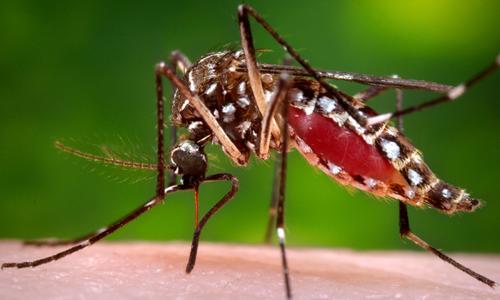
Dr Aamer said Australia had launched a bacterium namely “Wolbachia” which is transmitted to the mosquito. Once Wolbachia is transmitted in mosquito it remains in its DNA from generation to generation and does not allow it to transfer dengue to human beings.
Wolbachia is a genus of gram-negative bacteria that infects arthropod species, including a high proportion of insects, and also some nematodes.
“Though it is a complicated technology, in simple words the bacterium would be included in ponds so that it would transmit into the larva of dengue mosquito. After that it would remain in the mosquitoes and would not allow them to transmit dengue to human beings,” he said.
Dr Aamer said some countries such as Malaysia, Vietnam and Indonesia had introduced the technology and by March it would be transferred to Pakistan.
“Recently, a team from the Centers for Disease Control and Prevention (CDC) of United States visited Pakistan and appreciated our decision to control dengue through latest technology,” he said.
He said it had been decided that we would continue real time surveillance of the dengue situation in coming years.
“Moreover, 10 district surveillance centres have been established across the country and public labs for infectious diseases have been established in Quetta and Peshawar. Similar labs will also be opened in Lahore, Karachi, Muzaffarabad and Gilgit in near future,” Dr Aamer said.
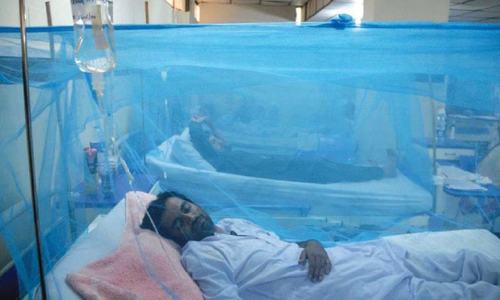
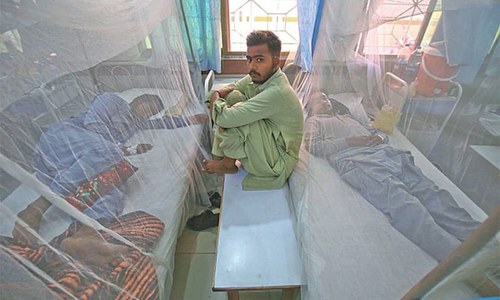
Dengue spreads by the mosquito bite and the patient faces deficiency of platelets due to which transfusion of platelets is required as the patient’s blood does not have the normal clotting ability. If timely treatment is not provided, the disease may turn into life-threatening dengue hemorrhagic fever. Fever may lead to bleeding, low levels of platelets and blood plasma leakage, or into dengue shock syndrome — a dangerously low blood pressure.
Published in Dawn, December 23rd, 2019