Lebanese protesters brave crackdown, return to the streets


BEIRUT: Thousands protested in Lebanon’s capital on Sunday, while Interior Minister Raya El-Hassan ordered security forces to open a “rapid and transparent” inquiry after dozens were wounded in clashes the night before.
Undaunted by the violence, demonstrators flooded central Beirut once more ahead of parliamentary consultations due to begin on Monday to appoint a new prime minister after weeks of largely peaceful street protests forced the previous cabinet to quit.
The unprecedented rallies have swept Lebanon since Oct 17, demanding the overhaul of a political system deemed inept and corrupt and the formation of an independent government of technocrats.
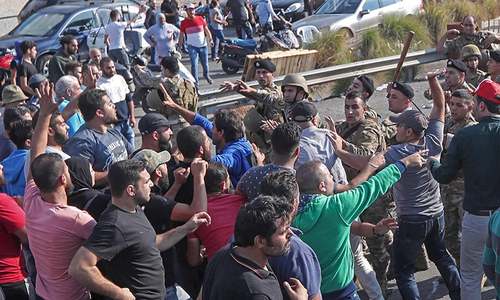
Late on Saturday security forces used tear gas and rubber bullets to disperse demonstrators who gathered near parliament, and beat protesters who tried to breach metal barricades.
The Lebanese civil defence said they took 36 injured to hospital and treated 54 people at the scene while the Lebanese Red Cross reported it took 15 injured to hospital and treated 37 people on site.
Both protesters and members of the security forces were injured, the Red Cross said, with some affected by tear gas and others struck by stones.
Lebanese security forces said on Twitter about 20 from their ranks were hospitalised, while others were injured and treated on the spot.
A photographer saw men in plainclothes hitting protesters, while anti-riot police fired rubber bullets at protesters throwing stones.
Hassan demanded the identification of those responsible for the most violent episode since the anti-government protests began in October.
She warned against “infiltrators” seeking to use protests to provoke “confrontations”.
Amnesty International’s Diala Haidar decried the “excessive use of force” in response to “overwhelmingly peaceful protest”.
“The intention was clearly to prevent protesters gathering,” she said, condemning the presence of masked men in civilian clothes joining security forces in “violently attacking protesters”.
The clashes lasted until the early hours of Sunday, with demonstrators chanting slogans against outgoing prime minister Saad Hariri, who stepped down on October 29, and parliament’s veteran speaker Nabib Berri.
The names of various potential candidates to replace Hariri have been circulated in recent weeks but powerful political parties in the multi-confessional country have failed to agree on a new premier.
Last Sunday the Sunni Muslim establishment threw its support behind Hariri returning, further angering protesters.
On Sunday afternoon they began gathering again in central Beirut to vent their wrath, as anti-riot police stood by.
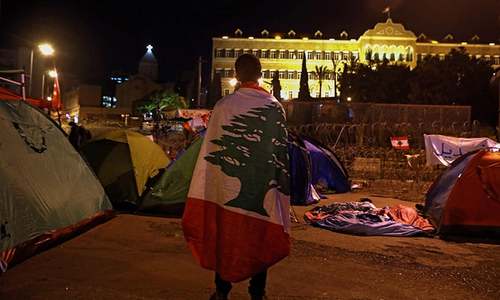
Waving Lebanese flags, they chanted slogans vowing “Hariri will not return”.
“Change needs time and patience and we will not stop until we achieve our goals and remove this regime completely,” Carla, a 23-year-old protester, said.
“We don’t want Hariri because he is a partner in (official) corruption”, she added. Nour, a pharmacist, said Saturday’s clashes were “shameful because we (the demonstrators) were peaceful and did not carry any weapons”.
“I am opposed to Hariri returning as head of the government and I don’t understand why they can’t find anyone else.
“There are many competent people... who are independent,” she said.
The head of the Internal Security Forces, Brigadier Imad Othman, toured central Beirut on Sunday afternoon and chatted with some protesters, urging them to be restrained.
“We must all be peaceful,” he told them, asking them to allow security forces to carry out their duties unhindered.
The process of forming a government will take place as Lebanon’s debt-burdened economy has been sliding towards collapse.
The country is facing a dollar liquidity crisis that has crippled imports and seen banks limit greenback withdrawals and transfers.
With banks failing to provide sufficient dollars, the US currency has been selling for more than 2,000 Lebanese pounds on the parallel market for the first time since it was officially pegged at 1,507 in 1997.
The international community has urged a new cabinet to be formed swiftly to implement key economic reforms and unlock international aid.
French Foreign Minister Jean-Yves Le Drian on Sunday urged Lebanese leaders to push to resolve the crisis paralysing the country.
“Political authorities should get moving because the country is in a dramatic situation,” he told French public radio. Parliamentary consultations are due to begin Monday at 10:30am.
Published in Dawn, December 16th, 2019