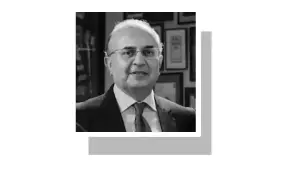
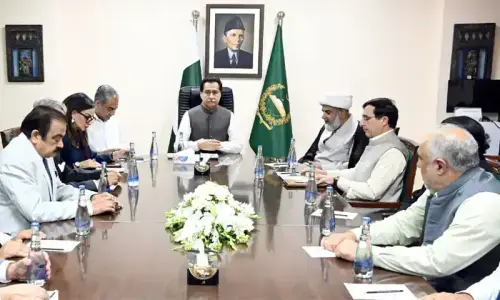
ISLAMABAD: Religious minorities are facing many issues today, but the media does not highlight them, Centre for Social Justice (CSJ) Executive Director Peter Jacob said on Sunday.
Speaking at a press conference, Mr Jacobs said: “It is a fact that most issues related to minorities are highlighted by the foreign media, and they reach Pakistan mostly through social media and discussed in the mainstream media.”
He remarked that a warm gesture and attitude between non-Muslims and Muslims can create a soft corner in the heart of a non-Muslim towards the Muslim community.
He recalled the experience of Harsh Mander, a civil servant who resigned from his job to protest the massacre of Muslims by Hindu extremists in Gujarat, India.
“I had the opportunity to meet Harsh Mander in Thailand and during our discussion it was revealed that at the time of partition his family migrated from Pakistan to India.
Activist urges action on forced conversions, offers recommendations for parliamentary committee
“He told me his mother wanted to see their ancestral home, which was in Rawalpindi’s [Sabzi] Mandi area,” he said.
He recalled Mr Mander telling him that he visited the house in Rawalpindi where they had lived and knocked on the door.
“He told the person who came out that they had once owned the house, and the person said, “This house is still owned by you.”
Mr Jacobs said Mr Mander told him the person received him and his mother warmly and that he “could not forget his attitude and behaviour” towards them.
Speaking in some detail about forced conversions, Mr Jacobs noted that on Nov 21 the Senate chairman and National Assembly speaker constituted a joint parliamentary committee to protect minorities from forced conversations.
The committee consists of 22 cross-party Senate and National Assembly members, including eight Hindu and Christian parliamentarians, he said.
“One expects this exercise to entail measures and outcomes that will engender a greater sense of security and protection of life, liberty and dignity among members of religious minority communities in Pakistan,” he said.
Mr Jacobs also referenced an investigative report that found that around 60 Christians converted to Islam in Lahore and its surrounding areas every month between 2009 and 2011 due to “economic pressures, security, etc.”
“According to a study carried out by the University of Birmingham, at least 2,866 cases of conversion involving women and girls were reported between January 2012 and June 2017 in Pakistan,” he said, adding: “During 2018, the National Commission for Human Rights received 30 complaints pertaining to violations of minorities’ rights, which included a number of forced conversions.”
Mr Jacobs also spoke about rumours that around 1,100 girls, 700 of whom are Christian, were trafficked to China and urged the media and law enforcement to investigate the issue and share the facts.
He said the CSJ has prepared recommendations that will be handed over to the committee, such as that the committee while laying down rules of procedure and terms of reference uphold the principles of religious freedom as laid down in the Constitution and interpreted in the June 19, 2014, judgement of the Supreme Court, which directs for the rights of minorities to be protected.
The committee should hold private and public inquiries with victims and their families, civil society, informed journalists and social activists to investigate the matter deeply and suggest concrete legal safeguards against forced conversions and marriages.
The CSJ has also recommended approaching the SC to introduce a moratorium on the validation of any marriages associated with conversions by any officer of the law until proper legislation is in place, in light of the magnitude of the issue, the impunity available to the culprit and the threat to peace and amity among communities.
A key component should also be introduced to judicial, administrative, police and legal officers training regarding accountability for offences related to abuse of religion, and those supporting forced conversions should be investigated and brought to justice, the CSJ suggested.
Published in Dawn, December 9th, 2019