NAJAF: The United Nations’ top official in Iraq and the country’s most senior cleric urged authorities on Monday to get “serious” about reforms after anti-government demonstrations that have left hundreds dead.
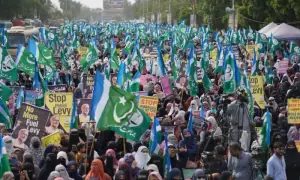
Mass rallies calling for an overhaul of the ruling system have rocked the capital Baghdad and the Shia-majority south since Oct 1 — the largest and deadliest popular movement in Iraq in decades.
The bloody unrest has sparked serious concern from the UN, human rights groups and the White House, which on Sunday called on Baghdad “to halt the violence against protesters” and pass electoral reform.
After weeks of paralysis, Iraq’s top leaders seem to have agreed to keep the system intact, but the UN in Iraq (UNAMI) urged them to enact a host of changes. These include electoral reforms within two weeks, the prosecution of those responsible for the recent violence as well as of corrupt officials and the passing of anti-graft laws.
On Monday, UNAMI chief Jeanine Hennis-Plasschaert met the country’s highest Shia authority, Grand Ayatollah Ali Sistani, in Najaf. She said the seat of Shia religious power (marjaiyah) in Iraq had stressed that “peaceful demonstrators cannot go home without sufficient reforms” to answer their demands.
“The marjaiyah expressed its concerns that the political forces are not serious enough to carry out such reforms,” said Hennis-Plasschaert. “If the three authorities — executive, judiciary and legislative — are not able or willing to conduct these reforms decisively, there must be a way to think of a different approach,” she warned without elaborating.
The UN has warned that “a climate of anger and fear has set in” and its human rights council was to meet for a periodic review of Iraq’s rights record.
The initial fissures among the political elite appear to have closed this week following a consensus brokered by Major General Qasem Soleimani, the head of Iran’s Islamic Revolutionary Guard Corps’ foreign operations arm.
Soleimani, who often appears in Baghdad in times of political crisis, has led a series of meetings with Iraq’s top-tier politicians, sources said. The agreement, they said, included a series of reforms in exchange for keeping the broader system in place.
Those proposals will likely fall short of the demands of protesters, who demand a complete overhaul of a regime they see as deeply corrupt.
Published in Dawn, November 12th, 2019