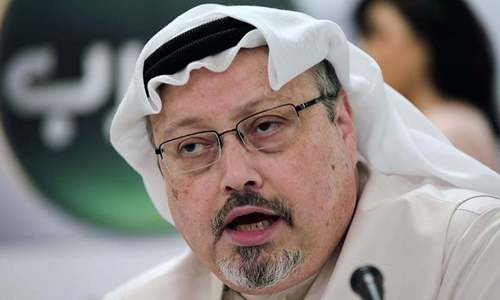
A YEAR ago today, Jamal Khashoggi walked into the Saudi consulate in Istanbul, never to re-emerge. The reports that have subsequently emerged about his final moments transcended all fears.
Khashoggi had been treated with courtesy when he visited the consulate the previous week to obtain proof that he was divorced. By the time he was asked to come back, a reception committee had been flown in from Riyadh, equipped with the means for dealing, Saudi-style, with a turbulent journalist.
It turned out the idea, as Shakespeare might have put it, was to cut the head off and then hack the limbs, like wrath in death and envy afterwards. Khashoggi’s remains have never been found. Maybe there was nothing left to conceal once the body parts had been boiled in acid at the consul-general’s residence.
Extreme brutality against journalists is not uncommon in the 21st century. No other nation, however, has gone to such grotesque extremes in silencing an inconvenient voice. The difference is arguably exemplified by Mohammed bin Salman, the heir to the custodian of the holy shrines.
In an interview broadcast in the past few days on US television, the Saudi crown prince admitted that the crime “happened under my watch”, but continues to insist he did not order the hit, thereby implying that some of his most trusted aides participated in the butchery without his direct knowledge. As if they would dare. Some of them may pay with their lives for their blind loyalty, but evidently not Saud al-Qahtani, who evidently remotely oversaw the grotesque operation.
For many, the Khashoggi killing was a short-lived affair.
For most nations and organisations that have intimate relations with Riyadh, the Khashoggi shock was a short-lived affair. Mohammed bin Salman never entirely became a pariah on the international stage, and many of those who aided his rehabilitation probably qualify as accessories after the fact. The most prominent among them makes no secret of his motivations. Donald Trump has explained his attachment to the kingdom by declaring that, well, “the Saudis pay cash”.
A great deal of that cash pays for the most sophisticated American weaponry. No country matches the kingdom in its outlay on arms imports. Yet none of that proved to be of any use in preventing last month’s attacks on Saudi oil refineries, for which Iran has been squarely blamed even though responsibility was immediately claimed by Yemen’s Houthi militia.
The Houthis even hinted that the attacks may partially have been mounted from within the kingdom. This possibility began to seem a little less incredible after another claim from the militia last weekend, saying it had killed or wounded 500 troops of the Saudi-led coalition and captured 2,000 in an operation that stretched into Saudi territory. Riyadh made no immediate effort to rubbish the claim — which, even if partially true, qualifies as a massive blow in a war that has pitched the region’s richest nation against its poorest, prompting a humanitarian disaster even Syria can’t match, with air raids that slaughter children, amid starvation and disease.
By any standards this qualifies as a far more heinous crime than the evisceration of an individual, and there is considerable irony in the fact that three of the nations — Britain, France and Australia — that last week called out some of Saudi Arabia’s domestic excesses at the UN Human Rights Council are complicit in the Yemen massacres through selling weapons to the regime in Riyadh.
The Saudi delegate responded with a not entirely misguided diatribe against Australia, which had spearheaded the resolution. The fact remains, though, that the assault against Yemen would be severely undermined, if not immediately halted, by the withdrawal of ongoing British and American logistical support, yet neither of them is inclined to curb its enthusiasm.
Mohammed bin Salman, meanwhile, continues to warn the West that if Iran is not restrained, oil prices could go through the roof. Perhaps he is disinclined to consider the likely consequences of an American assault against Iran, which would prompt the latter to target a great many more Saudi oil installations.
Whether the Saudi royal elite will fully realise in time where the crown prince has been leading the country — notwithstanding the ruling clique’s belated ‘liberalisation’ endeavours — is open to question. One would like to think that ultimately a popular revolt may turn out to be the better option in the longer run, but it would entail a great bloodletting and chaos.
But all is clearly not well in the kingdom. There could be more than meets the eye, for instance, in the murder of Major-Gen Abdulaziz al-Fagham, who served as King Salman’s leading bodyguard, notwithstanding the claim that he was the victim of a personal dispute.
It was a less messy outcome, though, than the personal dispute that led to the obliteration of Jamal Khashoggi — whose ghost, one hopes, will haunt the benighted kingdom for as long as it survives.
Published in Dawn, October 2nd, 2019