Baroghil: marching towards mainstream life

“LIFE is no more tiring and unpleasant for me in this valley and for the first time in 14 years, I’m set to pass the coming winter season here because basic necessities of life, including electricity, are now available,” says Tahira Bibi, the first matriculate from Baroghil valley. Obtaining her Master’s degree from International Karakorum University, Gilgit, last year, she said she avoided coming to the valley from Gilgit, where she preferred to stay in the hostel or put up in a relative’s home after colleges and the university closed for vacations because her valley was devoid of basic amenities.
“My father, who worked as a daily wage labourer in Gilgit and other cities, was daring enough to send me to Gilgit city for education from primary to Master’s level,” she said, adding that her sojourn in a city outside Baroghil valley made her feel sad because life there was still so primitive.
“Till 2013, the people of the valley had yet to see a vehicle and had to travel on foot to Yarkhoon Lusht village downstream for two days to board a jeep. They did not know about electricity, and even vegetables were new to them.
“Their diet was limited to bread made of a wild variety of barley native to the valley. Bread made of wheat was a luxury here,” according to Tahira.
She is now determined to stay in the valley as her village has been electrified, homes have heating arrangements and clean drinking water. Vegetables are now being grown as well.
She is grateful to the Aga Khan Development Network (AKDN) for bringing modern comforts of life to a valley which remained inaccessible in the absence of a road network.
Tahira is also enthusiastic about a road being built by the Aga Khan Rural Support Programme (AKRSP). Unlike an existing dirt track for jeeps which remains open only three months during the year, the nine-kilometre route from Kishman Ja village to Pech Aus, including two truckable suspension bridges, will provide all-weather access to Baroghil valley.
At present vehicular traffic is restricted to three months of the year because the road passes through a hilly terrain plagued by rock falls and landslides for nine months of the year.
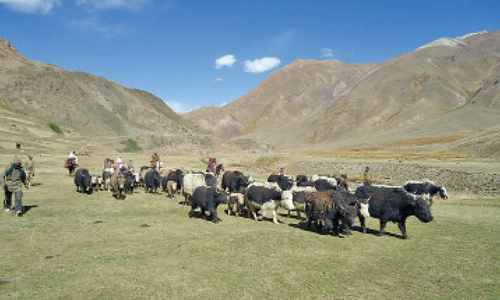
Baroghil, which flanks Afghanistan’s Wakhan corridor, is situated in the extreme north of Chitral district at a distance of 280km from the district headquarters. It is sparsely populated, with 2,000 people living in 13 contiguous villages.
It starts snowing from September and continues until early May; during this time, the locals virtually go into hibernation because the valley receives more than five feet of snow.
The major source of sustenance is livestock rearing, which meets their food requirements as well as fuel energy needs. Dung cakes are dried and stockpiled in the summer season.
The valley is surrounded by more than 10 glaciers, including the Chiantar glacier. Chitral River, which originates in this valley, is known as Kabul River in Peshawar valley after entering Afghanistan at Arandu border in the south.
The present dirt track to Ishkarwarz village, in the lower part of the valley, was built by the Pakistan Army. It was extended to four other villages up to Lashkargaz by the AKRSP, which erected a steel bridge over the river at Ishkarwarz village with financial assistance from Germany’s state-owned bank, Kreditanstalt fur Wiederaufbau (KfW). The Qurambar Lake, situated near the Pak-Afghan border, is inaccessible by road.
The intense cold weather which afflicts the valley for much of the year has led to an extremely high incidence of opium addiction among locals of all ages and both genders. It has not only pushed them further into poverty but also rendered them incapable of carrying out farming activities that can improve their quality of life.
Over the years, a surge in development activities has blessed the region with a network of bridges, water supply schemes, irrigation channels and walls to protect against floods.
Agriculture has arrived and model farms for vegetables and other cereal crops are coming up in different villages. “The AKRSP not only pioneered vegetable cultivation but also went a step further last year by hiring food technologists and professional cooks to demonstrate to villagers how to cook vegetables. Until then they did not even know how to peel onions,” observed Tahira.
The holding of Baroghil festival for the first time by the provincial government through the Tourism Corporation of Khyber Pakhtunkhwa is set to attract outsiders to the valley. Very few people from different parts of Chitral have had a chance to visit the area until now.
Tahira believes that the latest project has started bringing about a welcome change in the locals’ lives, but adds at the same time that there is still a long way to go.
The valley is home to rich biodiversity as it boasts snow leopard, Himalayan ibex, Marco Polo sheep, musk deer, brown bear and 83 species of birds. Tahira says that people of the valley will begin to appreciate the importance of the unique eco-system and the rich biodiversity of this region once they emerge from poverty.
Published in Dawn, October 2nd , 2019