Tunisian president, 1st democratic leader, dies at 92


 0
0


Tunisian President Beji Caid Essebsi, the North African country’s first democratically elected leader and heir to Tunisia’s founding father, has died. He was 92.
Essebsi died Thursday morning at the Tunis military hospital, where he was taken the night before, an official in the president’s office told The Associated Press. The presidential Facebook page said funeral plans will be announced soon.
Under Tunisia’s constitution, the president of the parliament will assume the presidency for 45 to 90 days while elections are organised.
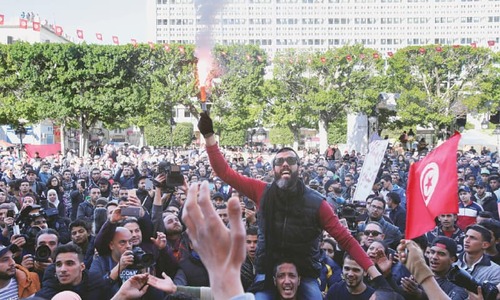
Essebsi won office in 2014 in the wake of the country’s Arab Spring uprising. He emerged from retirement to seek the presidency at age 88, presenting his centrist movement as a bulwark against rising Islamic fundamentalism and political chaos that rocked Tunisia after the people’s people’s revolt overthrew a longtime dictator and unleashed similar movements throughout the region.
But Essebsi was ultimately unable to bring prosperity or lasting calm to a country shaken by economic crises compounded by sporadic terror attacks.
Most of Essebsi’s political career came well before the Arab Spring. He was a symbol of Tunisia’s independence generation, though he outlived most of his peers who helped the country shake off French rule in 1956.
Born November 29, 1926 when Tunisia was a French protectorate, Essebsi entered politics in the 1940s and trained as a lawyer in Paris. But his name is most associated with Tunisia’s first president, Habib Bourguiba, who built up the country and educated its people — and brooked little opposition.
Essebsi proudly claimed to be Bourguiba’s disciple, and from 1965 to 1986, he held several senior roles including defense minister, foreign minister and interior minister.
After Bourguiba was overthrown in a bloodless coup by Zine el-Abidine Ben Ali in 1987, Essebsi took up a quiet life as a lawyer and author, until his re-emergence after the Arab Spring.
Tunisia remains a haven of political openness and relative peace compared to the strongmen elsewhere in the Arab world and the chaos reigning in Libya.
But the country has gone through nine governments since the 2011 uprising, and each one has failed to resolve widespread poverty, unemployment and disillusionment with democracy. Attacks by Islamic extremists, including some trained in neighboring Libya, have killed dozens and sent foreign tourists fleeing.
Threatened this year with a general strike, Essebsi acknowledged the problems he was unable to resolve.
“A democracy cannot be built in eight years,” he said in January. “Tangible results need time.”
Essebsi recently announced he wouldn’t run in the election scheduled for November, saying a younger person should lead the country.
Concerns had been growing about his fitness for office after he was hospitalised three times in recent weeks. His office released a video of the president meeting with the defense minister Monday, and Essebsi was visibly weakened.