In north Syria, the arts return to former militant bastion


RAQA: More than a year after the militant Islamic State group fled, Syrian boys and girls are finally back on stage — bobbing to the rhythm of drums in the northern city of Raqa.
Read: US-led coalition killed 1,600 civilians in Raqqa: report
At the first cultural centre to open since the jihadists’ draconian rule ended, sunlight floods into the brand new library, while books line shelves along a wall that still smells of wet paint.
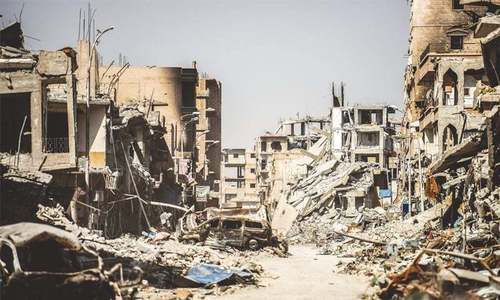
After almost four years under IS, which banned music and the arts, US-backed forces expelled the last IS fighters from Raqa in October 2017. But it’s taken a bit of time to resuscitate cultural life.
“I can’t describe how happy I am,” said Fawzia al-Sheikh at the centre’s opening earlier this month, in the still largely devastated city.
“After all this destruction, and no arts or culture, we finally have a centre where we can listen to song and poetry” again, the Raqa resident added.
In the Raqa Centre for Arts and Culture’s brightly lit gallery, paintings hang beside charcoal drawings, near sculptures of human figures.
In the concert hall, Malak al-Yatim stepped off stage after performing — exhilarated to finally be able to sing in public again. “I feel like a bird sweeping through the spring sky,” he said.
Yatim added that IS smashed his instruments and banned him from singing. “We were like nightingales in a cage,” he lamented.
“If we did anything, they’d chop off our head or whip us.” IS overran Raqa in 2014, making the city its de facto Syrian capital and imposing a brutal interpretation of Islam on everyone in its orbit.
— Books ‘saved from the ruins’
Before IS arrived, the city had more than 20 cultural centres, the largest housing 60,000 books.
But the extremists forced all these facilities to close, burning and destroying books and paintings.
But in the new centre’s library, hundreds of volumes that survived the extremists adorn shelves.
“These books you can see — we saved them from the ruins,” said Ziad al-Hamad, the centre’s director.
“During IS’ rule, residents hid them wherever they could,” added the 62-year-old, dressed neatly in a brown V-neck jumper over a stripy white shirt.
“When the city was liberated, they gave them back to us,” added Hamad, who also sits on the city council’s culture and antiquities commission.
The Kurdish-led and US backed Syrian Democratic Forces (SDF) expelled IS from the village of Baghouz, its last scrap of Syrian territory, in late March.
While the jihadists have continued to claim deadly attacks in areas controlled by the SDF — including Raqa — local artists have returned to their easels.
In the cultural centre’s gallery, painter Amal al-Attar has work on display after returning from exile in Beirut.
Among her works is a painting of a white boat adrift on an ocean, and another of a home on the shoreline.
“It’s like a re-birth,” the 37-year-old said of the centre’s opening, sunglasses perched atop her dark shoulder-length hair.
Attar used to run a studio for artists, but when IS overran the city they told her art was forbidden. She left 50 works behind when she fled to neighbouring Lebanon.
“IS burned them,” she said.
“I can’t forget what happened back then, but this cultural centre will give us a new drive,” she said.
Published in Dawn, May 13th, 2019