THE rush to use English as a medium of instruction in school, starting from the primary level, in Pakistan (as in some other former British colonies) was triggered by the failure of government schools in maintaining their once competitive learning standards. A major factor in this failure was that as school enrolment rose, governments did not provide adequate resources, trained teachers, a merit-based reward structure, proper curricula and infrastructure.
The falling standards of public schools became the basis for the growth of private schools that claimed a better learning experience using English as the medium of instruction. The global use of English in professions and business and the profit motive were the other driving forces.
Several recent studies in different countries have shown that the learning outcome in private (English-medium) schools is at best marginally better than in public schools that use the vernacular as the medium of instruction. Some studies have shown that students who have studied the first three to four years in the vernacular tend to outperform those who had English as the medium of instruction from the beginning.
Why not improve the public school system?
It makes sense that the vernacular should be the medium of instruction at all levels in school. For one thing, most of these children are part of a social milieu in which the mother tongue is the primary means of communication at home and outside. Interaction in the vernacular serves as the source of identity, social cohesion and cultural continuity. If children in this milieu learn in English at school, they develop a sense of otherness, even alienation.
Since access to private schools — they vary a lot in quality and expense — is unequal, it comes at a high social cost. There is good evidence that this course is not healthy for the individual or the family and community. Why not do the sensible thing?
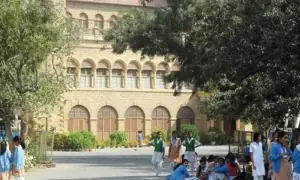
This takes me back to the British colonial model in the Indian subcontinent, of which I, like many others, had a happy experience. A vast majority of children were enrolled in government-funded schools — there were few private schools — in which the medium of instruction was one of the vernaculars. In my case it was Urdu.
The school curriculum included English and Urdu (or Persian or Hindi) along with arithmetic and geometry, geography, history, basic science, and arts and crafts. English was a required subject after the third year in school. The emphasis was on building a sound foundation for the language through grammar, composition and reading.
At the end of the tenth year (matriculation), a student was ready to transition to either practical life or post-secondary education in which English was the medium of instruction. At this stage, one was well equipped to work in the English language: four years at a college or university were enough to cope with spoken English.
Most of us did very well at university and later in our professions. The education in public schools was relatively inexpensive, good for building individual careers, and allowed school leavers to function as responsible members of society. This was true by and large until the mid-1960s.
Why not rejuvenate the public school system for the present age? Its requirements are not insurmountable — public investment in human capital has high returns for the individual and society. Make it accessible to all school-age children and make the learning experience pleasurable and rewarding. The curriculum at each level should be flexible but with a core comprising languages (vernacular up to at least seventh year and English from fourth year to the end of high school), mathematics, basic science, history, geography and civics (economy and society).
Students’ learning outcomes should be measured based on comprehension and analytical skills and not mere regurgitation of facts and ideas taken from books or imparted in the class room. Teachers should meet minimum requirements of education and training at entry and be inducted into service on merit alone. Their reward structure should provide incentives for performance and promotion. In-service training should be an integral part of a teacher’s career.
School infrastructure should be adequately funded and maintained. A decentralised governance structure should include school administrators, parents and community representatives, and teachers. Finally, poor households should be given a cash incentive to enrol and keep their children at school until they meet at least the minimum academic requirements.
Give the public school system a fair chance to succeed: give it adequate resources and competent management and give children the opportunity to learn in their own language until they complete their school education. Sure, teach English and other languages to compete in a fast-changing world. The good news is that apparently some of those holding the reins of power are waking up to pick and carry the baton. More power to them!
The writer is professor emeritus, Simon Fraser University, Canada.
Published in Dawn, March 18th, 2019