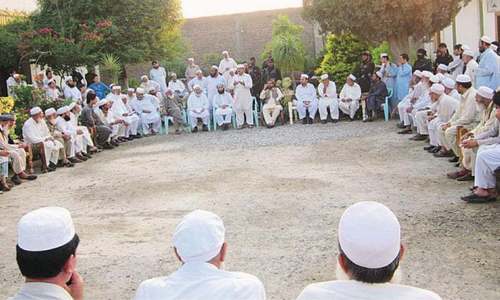
SC holds jirgas violative of Pakistan’s world commitments


ISLAMABAD: The Supreme Court on Wednesday held the system of jirgas and panchayats in violation of Pakistan’s international commitments under the Universal Declaration of Human Rights (UDHR), International Covenant on Civil and Political Rights (ICCPR) and Convention on the Elimination of all Forms of Discrimination against Women (CEDAW).
These commitments placed a responsibility on Pakistan to ensure that everyone had access to courts or tribunals and is treated equally before the law, a verdict authored by Chief Justice Mian Saqib Nisar said.
The decision came on a petition moved by the National Commission on Status of Women (NCSW) as well as the government of the Khyber Pakhtunkhwa (KP).
The genesis of the issue raised in the case lies in the reality that in today’s age, informal custom-driven parallel legal systems in the form of ‘council of elders’ or ‘kangaroo courts’ exist in tribal areas, particularly in the north of KP and in some rural areas of KP, Punjab, Sindh and Balochistan.
The NCSW, through its petition, had sought a declaration from the Supreme Court on the legality of jirgas/panchayats prevalent in the country, thereby challenging their operation as adjudicating bodies awarding judgements, executing punishments and deciding family, civil, criminal and other disputes.
A key question arising from the petition was whether to the extent that these informal village or tribal gatherings acted as courts in the form of jirgas or panchayats, they were illegal under the law in place read with international commitments made by Pakistan under various treaties/conventions.
National Commission on Status of Women had sought a declaration on the legality of jirgas, panchayats prevalent in the country
In response, the verdict held that the manner in which jirgas or panchayats functioned in the country was violative of Articles 4, 8, 10-A, 25 and 175(3) of the Constitution and explained that this practice of parallel judicial system did not fall under the constitution or any other law, because this system attempted to adjudicate on civil or criminal matters.
But jirgas or panchayats could operate within the permissible limits of the law to the extent of arbitration, mediation, negotiation or reconciliation forums between parties involved in a civil dispute who willingly consented to the same, the judgment said.
The verdict also declared as illegal and against the spirit of the constitution any order, decision or a directive issued by any such individual or group of persons, since no individual or persons in the name of a jirga/panchayat or under any other name could assume the jurisdiction of a civil or criminal court without any lawful authority.
The judgment also provided guidelines by holding that the law-enforcement agencies all over Pakistan were duty-bound to be vigilant and ensure that if any crime had gone unreported, they of their own accord filed FIR(s) with regard to the same and initiated the process of investigation, the verdict said.
If as a consequence of any illegal decision, order, directive or inducement of such self-appointed adjudicatory bodies any crime was committed, the offender as well as the individual or group of persons involved in aiding such jirga/panchayat shall be jointly held responsible for the offence and must be proceeded against in accordance with the law, the judgement said.
Moreover the police must ensure compliance with standard operating procedures (SOPs) which should be introduced by them within two months from the date of announcement of this judgement which should be circulated throughout the country with a compliance report to be submitted to the Supreme Court at the end of the two-month period.
The judgement also highlighted that after the 25th Amendment, there was no rationale on which the people of Fata could be distinguished from the people of the rest of the province of KP and thus the application of Fata Interim Regulation to one part of KP while the rest of the province enjoyed the protection of the provincial laws was absolutely unjustified, grossly discriminatory and in contravention of the fundamental right to equal protection.
On grounds of discrimination which cannot be justified under any reasonable classification and the law, the Fata Interim Regulation is declared as ultra vires on the touchstone of Articles 4, 8, 25, 175 and 203 of the Constitution.
The judgement also asked the KP government to develop infrastructure for taking steps in six months from the date of announcement of this judgement for a uniform system of courts of ordinary jurisdiction in KP, mandating the local law-enforcement agencies to ensure that the rule of law was observed by reducing jirgas/panchayats to arbitration forums which might be approached voluntarily by local residents to the extent of civil disputes only.
Published in Dawn, January 17th, 2019