Landslide warnings as Japan digs through rain devastation


 2
2


Desperate relatives braced for bad news on Monday as rescuers dug through landslides in the wake of severe floods that have killed more than 100 people and left swathes of central and western Japan under water.
With the toll mounting, Prime Minister Shinzo Abe cancelled a four-country foreign trip, the government's top spokesman said. Abe had been expected to visit Belgium, France, Saudi Arabia and Egypt from Wednesday.

As the floods receded, emergency workers reached previously cut-off places where authorities fear they could find more bodies in the wreckage of homes devastated by rivers of mud and debris.
“I have asked my family to prepare for the worst,” said Kosuke Kiyohara, 38, as he waited for word of his sister and her two young sons.
“I can't reach her phone,” he told AFP, sitting across from a house that had been ripped apart and tossed on its side by a huge landslide.
Rescue workers said it was still possible that survivors could be found, but acknowledged the odds were getting longer.
“It has been three days... It's possible that survivors will be found, but as the days pass the likelihood becomes slimmer,” a soldier at the scene told AFP.
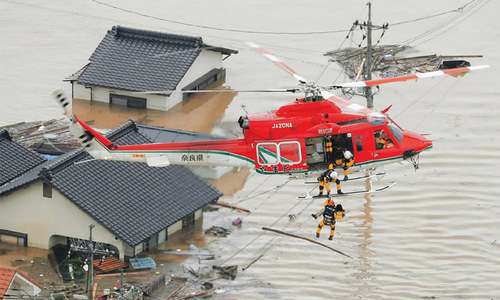
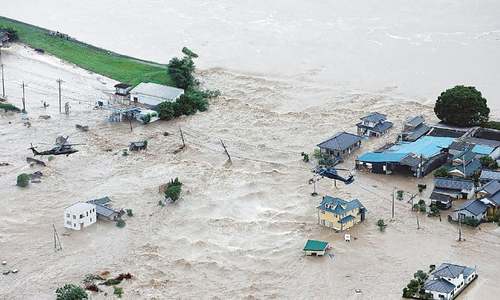
At the end of last week rivers engorged by more than a metre (three feet) as rain burst their banks, engulfing entire villages and forcing people on to rooftops to await evacuation by helicopter.
Hillsides gave way under the weight of water, with deadly landslides crushing wooden houses and erasing roads.
The government said at least 103 people had been killed, and with many people still missing, the tally was expected to rise further.
Search for survivors
Government spokesman Yoshihide Suga said 73,000 police, firemen and troops were taking part in the rescue effort, with 700 helicopters deployed to help.
In Kumano, soldiers and other emergency workers were using diggers to clear crushed cars and mangled homes and chainsaws to cut up tree trunks.
But they were moving carefully, looking as they went for survivors, or the remains of those killed in the disaster.

In one part of Kumano, the nose of a white car was just visible underneath the top floor of a home that had been torn from the rest of the building and swept down a hillside.
Water was still flowing from the surrounding hillsides around the feet of shellshocked residents, some of whom wept as they saw their damaged district.
In neighbouring Okayama prefecture, rescue workers flew in helicopters over areas that are still submerged and otherwise unreachable, looking for signs of life.
“As far as we could see from the helicopter, no-one is now waving for help,” a rescue worker from Kurashiki city told AFP.
Local government officials said pumping trucks were being deployed to help restore access to some of the worst-hit areas.
“Rescuers had to go by boat yesterday due to flooding but the water is gradually receding today,” a spokeswoman at the area's disaster control office said.
“If the water level drops low enough, they may be able to access hard-hit areas by road or on foot.”
Landslide risk
Even as the rains let up, authorities warned the downpours had loosened earth on hillsides and mountain slopes creating new risks.
“We urge residents to remain cautious about possible landslides,” a weather agency official told AFP.
And with many people stuck in modestly equipped shelters with few possessions, or living in damaged homes with no running water or electricity, the rising temperatures posed a new problem, authorities said.
At one point around five million people were told to evacuate, but the orders are not mandatory and many people remained at home, becoming trapped by rapidly rising water or sudden landslides.
In the town of Mihara, roads were transformed into muddy rivers, with dirt piled up on either side as flood water gushed around the wheels of stranded cars.
“The area became an ocean,” 82-year-old resident Nobue Kakumoto told AFPon Sunday, surveying the scene.
In the town of Saka, Eiichi Tsuiki opted to stay in his home, and survived only by moving to the top floor as flood waters rose, washing away cars outside.
“I've lived here for 40 years... I've never seen this before,” the 69-year-old oyster farmer told AFP.