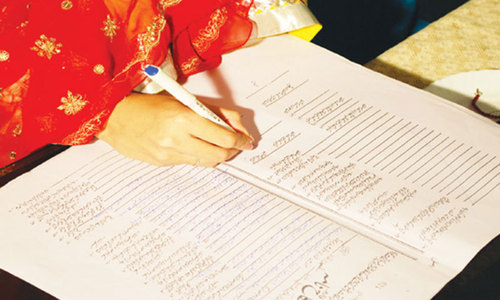
LONDON: The UK government is working on an amendment in the Marriage Act to make unregistered Nikah ceremonies a criminal offence.
The Department of Communities and Local Government has already published a green paper to elicit public opinion before sending the draft for legislation. The consultation period on the green is coming to an end on June 5.
According to the green paper, a prayer leader who participates in a Sharia-compliant religious ceremony (Nikah) can face prosecution if he does not ensure the couple has already registered their marriage legally beforehand or on the same day of the Nikah with the local registrar office.
Purpose of proposed amendment to law is to ensure Muslim women can apply for a divorce to courts instead of relying on Sharia councils
Christian and Jewish communities have similar conditions for their weddings.
It followed an Independent Review into the Application of Sharia Law in England and Wales which was ordered by Theresa May as Home Secretary.
The report of independent review published in February 2018 recorded a proposal to do so, by amending the Marriage Act, 1949, so that the celebrant of any marriage such as an imam, would face penalties for failing to ensure that the wedding was civilly registered.
The Independent Review into the Application of Sharia law in England and Wales was carried out by a panel headed by Mona Siddiqui OBE, Professor of Islamic and Interreligious Studies at the Divinity School, University of Edinburgh, while Leeds Makkah Masjid Imam Qari Muhammad Asim MBE and Shia scholar Imam Sayed Ali Abbas Razawi were among other members.
The main purpose of the proposed amendment is to ensure that Muslim women can apply for a divorce to British courts instead of relying on the Sharia councils, many of them run by mosques and Islamic centres.
Statistics in the report suggest that a large number of Muslims living in the UK have not been legally married as their unions have not been registered. According to the report, 100,000 Muslim women who have had their Nikah in Islamic ceremonies have not registered their marriages, depriving them their right to get divorce from the normal family courts.
It was earlier observed in an integration report by former civil servant Dame Louise Casey that the Sharia councils were being used to marginalise Muslim women, particularly in Pakistani and Bangladeshi communities.
Although the government is proposing the amendment in marriage act to protect rights of Muslim women, it is seen as a measure to have far-reaching implications. Currently, a number of Muslims from Pakistani and Bangladeshi background are getting married in religious ceremonies supervised by imams of local mosques and Islamic centres who, in some cases, supervise Nikahs without checking the immigration status of the couple. This enables them to apply for spouse visa here in the UK without going back to their respective countries which is a requirement for obtaining such a visa. Their presence in the country enables them to appeal against any adverse decision on the ground of human rights, frustrating the efforts of the immigration enforcement officials to deport illegal immigrants.
Dr Iqtidar Karamat Cheema, director at Birmingham-based Institute of Leadership and Community Development, welcomed the government initiative.
“It is concerning that majority of Muslim women in the UK who have had a traditional Muslim wedding ceremony Nikah do not go for a civil marriage registration. Hence their marriages are not recognised legally. If the marriage breaks down, women have no entitlement to spousal rights, including division of assets, such as the family home and spouse pension”, Dr Iqtidar Cheema told Dawn.
“In order to safeguard women’s right which has been granted by the Quran and by Prophet Muhammad himself, it is important that Muslim couples should undergo a civil marriage as well as a religious ceremony to give women protection under the British law,” he added.
The independent review had also recommended establishment of an official body to kick-start self-regulation by the Sharia councils but the Home Office rejected this recommendation fearing such a move might undermine British law.
“Sharia law has no jurisdiction in the UK and we would not facilitate or endorse regulation, which could present councils as an alternative to UK laws”, a Home Office spokesman said when the Independent Review was published.
“In Britain, we have a long tradition of freedom of worship and religious tolerance, where many people of different faiths follow religious codes and practices and benefit from their guidance. The government has no intention of changing this position,” he said.
Published in Dawn, June 2nd, 2018