96
96

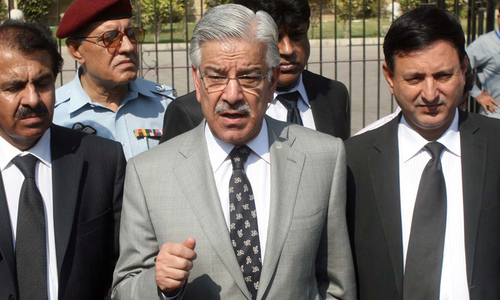
The Supreme Court (SC) on Friday overturned an April decision of the Islamabad High Court (IHC) to disqualify PML-N leader and former foreign minister Khawaja Asif for life.
A three-judge bench headed by Justice Umar Ata Bandial announced its decision on a May 2 appeal by Asif after earlier reserving its decision following the conclusion of arguments from both sides
Asif's senior counsel, Munir A. Malik, confirmed the development while speaking to Dawn. "Khawaja Asif can contest the upcoming election," he said.
Take a look: Iqama — the missing link with Panama?
Malik had argued that his client had revealed all the details required in his nomination papers.
"The sword of disqualification should not be looming over parliamentarians' heads in this way," he had asserted.
He continued, saying that if his client's income was greater than his declared sources of income, the Election Commission of Pakistan could look into the matter.
"The investigation of greater income than resources falls within the ECP's ambit," he had said.
The Supreme Court has yet to issue a detailed order in the case.
Disqualified for life
On April 26, the IHC had disqualified Khawaja Asif as a member of the parliament under Article 62(1)(f) of the Constitution for not disclosing his employment in a UAE company as an occupation as well as the monthly salary he was receiving.
Pakistan Tehreek-i-Insaf (PTI) leader Usman Dar had moved the high court against Asif in 2017. In his petition, he had argued that Asif did not declare his job in the United Arab Emirates (UAE) and his salary in the 2013 nomination papers. Asif, however, had contended before the court that he declared AED50,000 as foreign income in papers.
Addressing the argument by Asif's legal team that "since copies of the passport attached with the nomination paper also contained a copy of the 'iqama', therefore there was no misrepresentation or concealment", the IHC judgement says: "Iqama is merely a residence visa issued by the immigration officials. In the instant case, the non-disclosure was that of the employment as an occupation and the salary per month received thereunder."
The judgement also made a reference to the Panama Papers case, saying: "Supreme Court has not disqualified the former prime minister [Nawaz Sharif] merely for holding an ‘Iqama’ but rather his disqualification was due to non-disclosure of assets; holding an ‘Iqama’ cannot be made the basis for attracting Article 62(1)(f)."
Last month, Khawaja Asif had challenged the verdict in the apex court. The counsel for Asif had argued that the April 26 IHC decision was an exception taken against an elected parliamentarian.
In the petition, Asif argued that an inadvertent omission to disclose in his nomination papers, a bank account which represented less than 0.5 per cent of his total assets, particularly when the account lay dormant though it was disclosed in the annual statement of assets and liabilities filed with the Election Commission of Pakistan before the writ was instituted, could not be treated as willful and dishonest concealment.