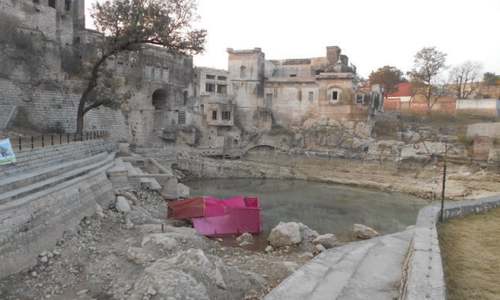
Noting that water worth billions of rupees was used by cement factories around the historic Katas Raj temple without any payment, the Supreme Court on Wednesday issued a two-day deadline for the factories to submit recommendations for a policy on payment of water used in the past and that to be consumed in the future.
A three-member SC bench headed by Chief Justice (CJP) Mian Saqib Nisar was hearing a suo motu case based on media reports that the Katas Raj pond is drying out due to water consumption by nearby cement factories.
Justice Nisar observed during the hearing that the cement factories had caused damage to the environment by using up the area's water as well as causing air pollution.
"The people who are not doing anything for water are not sincere with this country; those taking no measures for water [provision] are enemies of this country," the CJP remarked.
The CJP said factory owners must have used influence to get permission to establish cement factories in the area.
He admonished a former secretary industries, Khalid Sherdil, "for giving away everything for free", at which the official responded that a no-objection certificate was not a requirement when the factories were established.
The CJP noted that the factories had not taken any measures to resolve the issues voluntarily and that the owners only think of their own profits.
"We should close Bestway Cement. Allah will have his mercy and production will be met [through other sources]," he commented.
He also said he would visit the factories himself to examine the situation regarding pollution caused by the factories.
"Cement factories should pay up to get water from the river," he said, ordering the factories to give recommendations as to how much they are willing to pay for the water they have already used and what the rate for future usage of water should be.
"The impression that in the absence of law, a wrong act would become right is false," Justice Umar Atta Bandial observed, adding that theft was a crime under all circumstances.
The CJP also ordered the factories to take measures to prevent air pollution while directing the Punjab government to install pipelines to provide water to the factories.
Meanwhile, Justice Ijazul Ahsan noted that 2.5 million gallons of water were used by the factories every day. "Cement factories pulled out a sea from underground sources."
The case was adjourned until 7:30pm today.