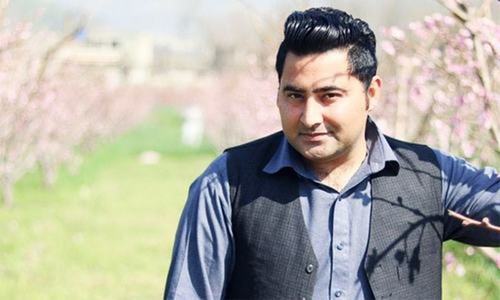
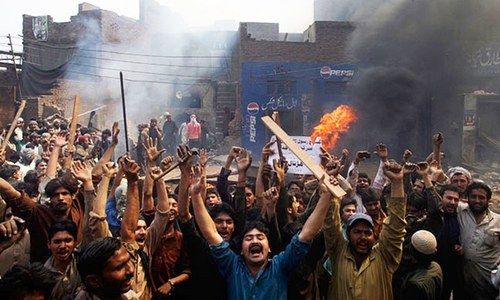
PESHAWAR: When Ziaullah Hamdard appeared before the Joint Investigation Team to record his statement in Mashal Khan’s murder case, he would quote from the holy Quran when he spoke to people or policemen.
Those who know him are aware that Hamdard has a religious background. Not one to wear that badge on his sleeve, he went out of the way to dispel doubts — real or perceived — about his religious credentials.
How else does one validate the legitimacy of one’s faith to finger-pointing mobs that see those supporting someone accused of blasphemy as being guilty of the same act?
How does one save oneself from the murderous stain that bled in the corridors of Abdul Wali Khan University, Mardan, on April 13 last year?
Mashal is dead but the witnesses to his murder, and his family, live in fear.
Now that their testimonies have led to convictions, they face consequences in a milieu where religio-political parties and religious groups that protest convictions openly incite hatred against those seeking justice for Mashal.
Also read: Is the Mashal Khan lynching case verdict exemplary or worrisome?
The last time we met, Hamdard was in a small dank room inside a police complex in Khyber Pakhtunkhwa. The room belonged to police guards and an elderly bearded man in plain clothes sat sentinel by the door.
Hamdard looked thin, pale and manic from lack of light and sleep. There were bugs in the bed and as we spoke, a rat rattled the contents of a drawer in a table. It was the kind of room you couldn’t bring enough light to, the kind where gloom clung to walls, floor and roof like soot. A lone bulb hanging at its centre did little to dispel it. This was the only room police had for him when he asked for security after receiving threats.
The Supreme Court had asked the provincial government to provide security to witnesses. Even when he feared going out to community bathrooms, uneasy at the prospect of being among unknown men who could potentially harm him, Hamdard was grateful for the room, the two guards and the vehicle provided to him to move around.
A lecturer at the Abdul Wali Khan University, Mardan, and a key witness in Mashal Khan’s murder, no one at the police station knew who Hamdard was.
Yet in a country where the governor of the federation’s most powerful province was killed by his guard for defending a woman accused of blasphemy, he said, nowhere was safe, not even Police Lines.
And yet, people at the Police Lines must have known who he was, for he spoke frequently on TV about Mashal Khan’s case. The police had cautioned him against it. But his statements in the case — turned controversial by obfuscation of facts by the university administration, a smear campaign against Mashal Khan on social media and support for his murderers by religious and political parties — were critical to establish culpability of the accused.
Hamdard, who was there in the midst of events leading to Mashal’s murder, had resigned in protest from the university for accusing the youth of blasphemy.
Mashal Khan: For lighting a flame in our hearts by losing his life
“I had the facts first hand, I knew the university administration was involved [in instigating the murder] and using blasphemy as a bogey to hide behind.”
The JIT report on the case validated Hamdard’s stance. He said that 80 per cent of the JIT report was based on his statements and his court testimony had got one suspect imprisoned for life.
“Speaking to the police and people during that time, I would recite the holy Quran so much, I came to memorise half of it,” says Hamdard. “It was the only way I could ensure that people think of me as a practising Muslim because the clergy had painted witnesses and supporters of Mashal as blasphemers too.”
In this, Hamdard is not alone. Such is the threat and threat perception among those related to the case, even Mashal’s family take pains to provide testimonials to his religious beliefs and theirs.
“Soon after Mashal’s lynching, everyone stood by the killers who are from influential families,” he says. “No one stood up for Mashal, Abdullah and Zubair [the two students accused of blasphemy alongside Mashal].”
Abdullah, who fled to Saudi Arabia, couldn’t afford travel expenses. A police official and a politician had donated money to get him out.
“Mashal’s murder has left many at the mercy of people who celebrate and glorify killers. As a result of the state’s policies, intellect, wisdom and creativity are dying as the society slides towards darkness.”
Security concerns keep him moving, frequently changing locations. Both Abdullah and Zubair have gone underground. Mashal’s sisters have abandoned education, their house guarded by police. They will live with this threat for the rest of their lives, says Hamdard, marked for having stood up for an innocent man murdered in the name of blasphemy.
Published in Dawn, April 13th, 2018